 CattleScale
How to estimate cattle weight without scales
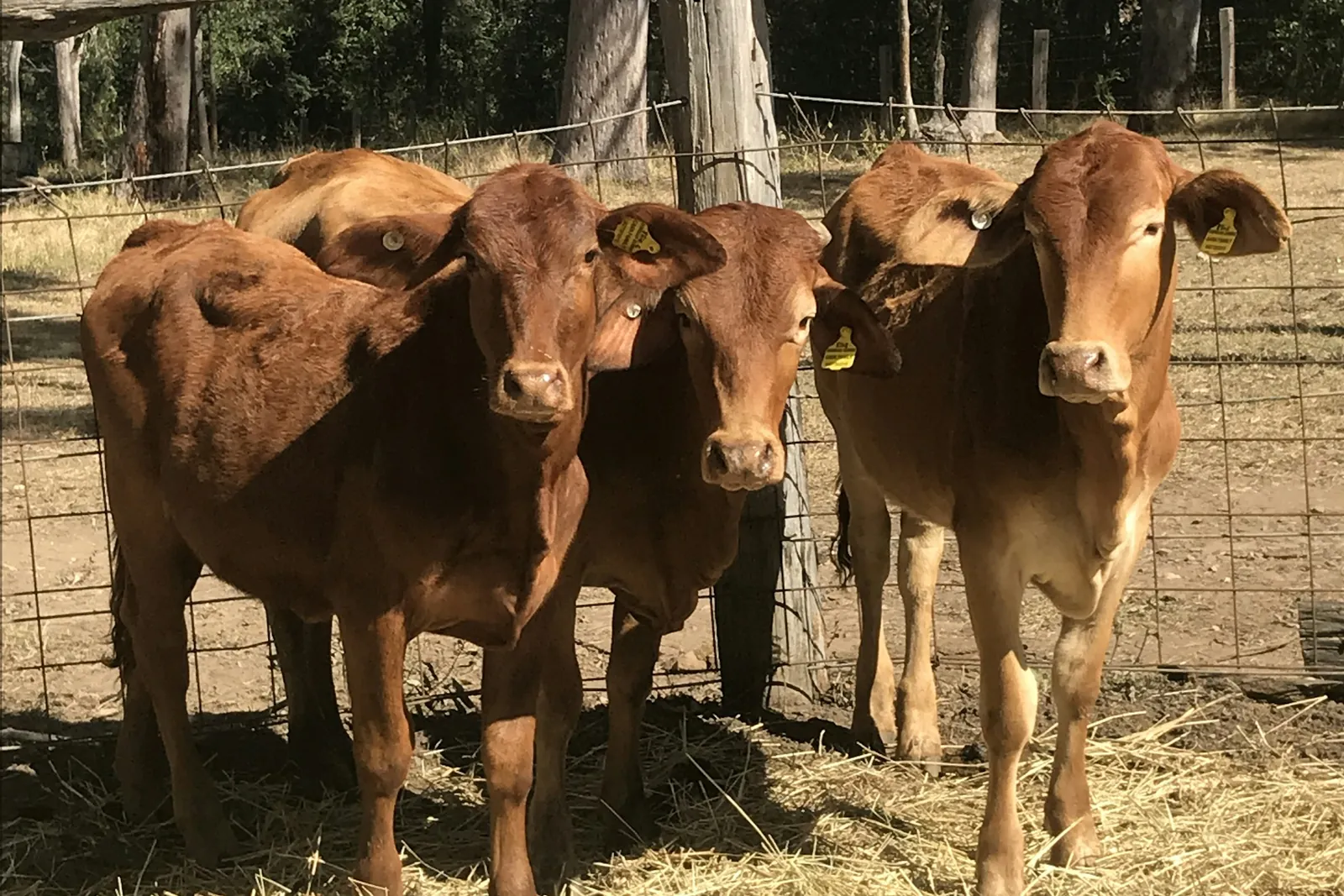
No crush, no load bars, and you still need a number. Here is what each scale-free method can and cannot tell you about a beast's live weight, according to Australian extension guides and the published research.
Why estimate cattle weight without scales?
Measuring live weight is "one of the most important production tools available to farmers", with a role in nutrition, fertility management, health and marketing (Goopy et al. 2018). But plenty of smallholders have no crush or scales, so they estimate.
It helps to know that even a scale reading moves around. In adult cattle, gut fill can account for 12 to 25 per cent of live weight, and a 400 kg animal can lose about 25 kg over 6 hours off feed and water (Wythes 2011). Any method you use is chasing a number that changes through the day.
How do you measure heart girth on a cow?
Heart girth is the distance around the chest, taken in line with the heart. Oregon State University Extension's weight calculator gives two measurements for cattle (Oregon State University Extension Service n.d.):
- Heart girth: the circumference of the animal, measured "in relation to the location of the animal's heart".
- Body length: from the point of the shoulder to the pin bone.
Who holds the tape matters. In a UK calf study, about a third (32 per cent) of the variation in tape readings came down to the person measuring (Sherwin et al. 2021). Have the same person measure each time.
What is the girth times length formula?
The formula published by Oregon State University Extension for cattle is:
Weight (lb) = heart girth (in) x heart girth (in) x body length (in) / 300
Their worked example is a beef cow with a 70 inch girth and 78 inch body length, which gives 1,274 lb (Oregon State University Extension Service n.d.). Researchers call this Schaeffer's formula, and note it has been widely promoted on social media as a way to estimate weight (Carrasco-Guzman et al. 2025).
If you measure in centimetres, converting the units gives roughly: weight (kg) = girth (cm) x girth (cm) x length (cm) / 10,840. For example, a 180 cm girth and 150 cm length works out to about 448 kg. That is a unit conversion of the same formula, not a separately tested equation.
How accurate is a heart girth tape?
It depends on the cattle.
- In 119 pre-weaned dairy-breed calves, tapes estimated individual weights with a mean absolute error of 2.66 kg (Sherwin et al. 2021).
- In African smallholder cattle, heart girth was not sensitive enough to track seasonal weight changes (Goopy et al. 2018).
- In 432 admixed Sudanese zebu cattle, the worst 5 per cent of predictions from heart girth models were more than 20 per cent out (Alkhtib et al. 2021).
- In 254 crossbred dairy cows and heifers in Mexico, the Schaeffer formula's predictions were strongly correlated with scale weight (0.96 or better), but the authors found reliability and agreement with actual weight were low, and a competing formula did better (Carrasco-Guzman et al. 2025).
Body shape is a big reason for the spread. Queensland research found non-pregnant Bos taurus females were 10 to 40 per cent heavier than Brahmans at the same hip height and body condition (Fordyce et al. 2013). Two animals of the same height and condition can weigh quite differently.
How accurate is estimating cattle weight by eye?
- An early Australian study had recorders assess young beef calves by sight. Calves the recorders put in the top third differed from the bottom third by 17.4 kg, while the real difference on the scales was 31.6 kg (Morris et al. 1981). The eye got the direction right but missed much of the gap.
- In the Sudanese study, the worst 5 per cent of estimates by a breeder and five cattlemen were more than 20 per cent out (Alkhtib et al. 2021).
- A 2014 University of Minnesota project, as reported by Progressive Cattle, found veterinarians, stockmen and students typically missed by over 10 per cent. Weight was usually underestimated, and accuracy got worse as the animals got heavier (Yost 2026).
To be fair to the eye, a Mexican study of 105 crossbred beef heifers found visual assessment correlated well with scale weight (0.92), not far behind heart girth (0.95) (Alejandro-Zarate et al. 2023). The catch is that you rarely know how far out your own guesses run until you check them on a scale.
Is body condition score the same as weight?
No. Body condition score describes fat cover, not size. Meat & Livestock Australia's More Beef from Pastures manual says condition score "provides an estimate of fat reserves that is independent of size" (Meat & Livestock Australia n.d.). It is scored hands-on by feeling the short ribs and the tail head.
Australian guides use different scales: 1 to 6 in More Beef from Pastures (Meat & Livestock Australia n.d.), 1 (poor) to 5 (fat) at FutureBeef (FutureBeef 2024), and 0 to 5 in MLA's national guide to cattle in low body condition (Meat & Livestock Australia 2013). Always say which scale you mean.
Condition does affect weight. In the Queensland study, live weight varied by 12 to 14 per cent for each condition score as cows moved away from moderate condition, on a 5-point scale (Fordyce et al. 2013). Combining hip height, condition score and other measures, the team predicted the live weight of post-weaning age females to within 10 per cent in 65 per cent of cases and within 23 per cent in 95 per cent of cases.
Can you estimate cattle weight from a photo?
Researchers are working on it, but the headline numbers come with conditions attached. A systematic review of 26 studies on cattle and pigs found 3D depth cameras were the most preferred equipment and deep learning was still rarely used (Dohmen, Catal and Liu 2022). Two recent studies:
- On two Norwegian beef farms, a study using 1,289 images from a depth camera reached a best mean absolute percentage error of 3.29 per cent and a best mean absolute error of 14.35 kg. Plain colour images worked better than the depth data (Afridi et al. 2024).
- A side-view study of 513 cattle in Bangladesh reported a mean absolute error of 18.02 kg and a mean absolute percentage error of 6.22 per cent. The authors noted the model was only tested on Bangladeshi breeds, mostly between 200 and 400 kg, and had not been tested in low light or with fences blocking the view (Hossain et al. 2025).
Those results come from known herds and particular breeds. A phone photo of a different breed, taken at an angle across a paddock, is a harder problem.
How do the methods compare?
| Method | Equipment | What studies report |
|---|---|---|
| Eye estimate | None | Worst 5% of guesses more than 20% out in zebu cattle (Alkhtib et al. 2021); correlation of 0.92 with scale weight in crossbred beef heifers (Alejandro-Zarate et al. 2023) |
| Heart girth tape | Weigh tape | Mean absolute error of 2.66 kg in pre-weaned calves (Sherwin et al. 2021); worst 5% of predictions more than 20% out in zebu cattle (Alkhtib et al. 2021) |
| Hip height plus condition score | Measuring stick, trained scorer | Within 10% in 65% of cases and within 23% in 95% of cases, tropical female cattle (Fordyce et al. 2013) |
| Computer vision (research) | Depth camera or side-view images | 3.29% best mean absolute percentage error on two Norwegian farms (Afridi et al. 2024); 6.22% on side views in Bangladesh (Hossain et al. 2025) |
| Scale | Load bars or platform | Still moves with gut fill: a 400 kg animal can lose about 25 kg over 6 hours off feed and water (Wythes 2011) |
When do you need a real scale?
- Drenching and dosing. Drench doses are set by weight. WormBoss advice for sheep is to set the drench gun by the weight of the heaviest animal in the group, because underdosing "will selectively kill the most genetically susceptible worms, leaving behind the more drench resistant types to breed" (Kahn 2016). If an eye estimate runs low, as the Minnesota project found it usually did (Yost 2026), the dose runs low too. Weigh, or ask your vet.
- Selling by weight. A price per kilogram should rest on a scale weight, not an estimate.
- Measuring growth over weeks. Tapes were unreliable for short-term weight gain in individual calves (Sherwin et al. 2021), and heart girth missed seasonal changes in African cattle (Goopy et al. 2018).
Estimates earn their keep in rough planning, such as sorting a mob into lighter and heavier groups.
Where does CattleScale fit?
CattleScale is a phone app that estimates live weight from a side on photo. It infers the height at the shoulder, body length and heart girth from the picture, then runs the same girth and length formula described above and weighs that against a direct visual estimate, leaning on the formula more when the girth reading is better. Every reading comes with a range and a Low, Moderate or Good confidence rating, plus a plain-English list of what hurt the reading, such as nothing of known size in frame or a poor angle.
We publish what we have measured. In our first test, on 70 scale-weighed cattle photographed with nothing of known size in frame, the typical error was about 23 per cent, and the true weight fell inside the shown range about four times in ten. A newer model, re-run on all 72 of those cattle in October 2026, did no better at about 23 per cent, so without a measured scale the app now shows a wider range, from 25 per cent under its estimate to 50 per cent over, which held the true weight about eight times in ten on that test. The formula itself is within about six per cent when fed a real tape, so most of the error is in reading measurements off pixels. The full detail is in our accuracy FAQ.
It is an estimate, not a weigh scale. Do not buy, sell or dose on it.
Frequently asked questions
Can you weigh a cow with a tape measure?
You can estimate weight with a tape, not weigh it. Accuracy varies by herd: one calf study found a mean absolute error of 2.66 kg, while in admixed zebu cattle the worst 5 per cent of heart girth predictions were more than 20 per cent out.
What is the formula for cattle weight using girth and length?
Oregon State University Extension gives heart girth x heart girth x body length / 300 = weight in pounds, with measurements in inches. Body length runs from the point of the shoulder to the pin bone.
How accurate is guessing cattle weight by eye?
Usually not very. In one study the worst 5 per cent of estimates by a breeder and cattlemen were more than 20 per cent out, and a US project found weights were usually underestimated, more so in heavier animals.
Is body condition score a measure of weight?
No. MLA describes condition score as an estimate of fat reserves that is independent of size. Two animals with the same score can weigh very different amounts if their frames differ.
Can I drench cattle based on an estimated weight?
It is risky. Underdosing selects for drench-resistant worms, and eye estimates tend to run low. Weigh the animal or ask your vet before dosing.
References
- Afridi, H., Ullah, M., Nordbø, Ø., Hoff, S.C., Furre, S., Larsgard, A.G. and Cheikh, F.A. (2024) 'Analyzing data modalities for cattle weight estimation using deep learning models', Journal of Imaging, 10(3), 72. Available at: https://doi.org/10.3390/jimaging10030072 (Accessed: 1 October 2026).
- Alejandro-Zarate, M.I., Salazar-Cuytun, R., Herrera Camacho, J., Cruz-Hernandez, A., Barrientos-Medina, R.C., Ptáček, M., Vargas-Bello-Perez, E. and Chay Canul, A.J. (2023) 'Comparison between visual assessment and measurement of heart girth or hip-width to estimate live weight in crossbred beef heifers', Tropical and Subtropical Agroecosystems, 26(3), 5033. Available at: https://doi.org/10.56369/tsaes.5033 (Accessed: 1 October 2026).
- Alkhtib, A., Almasri, O., Burton, E. and Wamatu, J. (2021) 'Eyeballing and heart girth models for live weight estimation of highly admixed Sudani shorthorn zebu cattle for precise production and veterinary services', Jordan Journal of Agricultural Sciences, 3, pp. 63-75. Available at: https://repo.mel.cgiar.org/items/82e2971f-f74d-4024-bc7c-efcccdb9e260/full (Accessed: 1 October 2026).
- Carrasco-Guzman, M.E., Barrientos-Medina, R.C., Arcos-Alvarez, D.N., Casanova-Lugo, F., Pozo-Leyva, D. and Chay-Canul, A.J. (2025) 'Reliability and concordance of Schaeffer and Agarwal formulae for predicting crossbred dairy cattle weight', Ecosistemas y Recursos Agropecuarios, 12(1), e4245. Available at: https://doi.org/10.19136/era.a12n1.4245 (Accessed: 1 October 2026).
- Dohmen, R., Catal, C. and Liu, Q. (2022) 'Computer vision-based weight estimation of livestock: a systematic literature review', New Zealand Journal of Agricultural Research, 65(2-3), pp. 227-247. Available at: https://doi.org/10.1080/00288233.2021.1876107 (Accessed: 1 October 2026).
- Fordyce, G., Anderson, A., McCosker, K., Williams, P.J., Holroyd, R.G., Corbet, N.J. and Sullivan, M.S. (2013) 'Liveweight prediction from hip height, condition score, fetal age and breed in tropical female cattle', Animal Production Science, 53, pp. 275-282. Available at: https://doi.org/10.1071/AN12253 (Accessed: 1 October 2026).
- FutureBeef (2024) 'Body condition score for beef cattle', FutureBeef. Available at: https://futurebeef.com.au/resources/body-condition-score-for-beef-cattle/ (Accessed: 1 October 2026).
- Goopy, J.P., Pelster, D.E., Onyango, A., Marshall, K. and Lukuyu, M. (2018) 'Simple and robust algorithms to estimate liveweight in African smallholder cattle', Animal Production Science, 58(9), pp. 1758-1765. Available at: https://doi.org/10.1071/AN16577 (Accessed: 1 October 2026).
- Hossain, M.J., Ferdaus, J., Islam, A. and Amin, M.A. (2025) 'CattleNet-XAI: an explainable CNN framework for efficient cattle weight estimation', PLoS One, 20(11), e0336434. Available at: https://doi.org/10.1371/journal.pone.0336434 (Accessed: 1 October 2026).
- Kahn, L. (2016) 'Use the right dose of drench: under and overdosing and implications for drench resistance', WormBoss, ParaBoss. Available at: https://tools.wormboss.com.au/sheep-goats/news/articles/drenches/use-the-right-dose-of-drench-under-and-overdosing-and-implications-for-drench-resistance.php (Accessed: 1 October 2026).
- Meat & Livestock Australia (2013) A national guide to describing and managing beef cattle in low body condition. Sydney: Meat & Livestock Australia. Available at: https://www.integritysystems.com.au/globalassets/isc/pdf-files/lpa-documents/a-national-guide-to-describing-and-managing-beef-cattle-in-low-body-condition.pdf (Accessed: 1 October 2026).
- Meat & Livestock Australia (n.d.) 'Tool 5.02: Condition scoring beef cattle', More Beef from Pastures. Available at: https://mbfp.mla.com.au/weaner-throughput/tool-52-condition-scoring-beef-cattle/ (Accessed: 1 October 2026).
- Morris, C.A., Smith, R.J., Hearnshaw, H. and Dicker, R.W. (1981) 'The accuracy of visual assessments for weight in young beef calves', Australian Journal of Experimental Agriculture and Animal Husbandry, 21(108), pp. 19-26. Available at: https://doi.org/10.1071/EA9810019 (Accessed: 1 October 2026).
- Oregon State University Extension Service (n.d.) 'Weight calculator'. Corvallis: Oregon State University. Available at: https://extension.oregonstate.edu/sites/default/files/documents/51006/weightcalculator.pdf (Accessed: 1 October 2026).
- Sherwin, V., Hyde, R., Green, M., Remnant, J., Payne, E. and Down, P. (2021) 'Accuracy of heart girth tapes in the estimation of weights of pre-weaned calves', Veterinary Record Open, 8(1), e16. Available at: https://doi.org/10.1002/vro2.16 (Accessed: 1 October 2026).
- Wythes, J. (2011) 'Liveweight loss and recovery in cattle', FutureBeef. Available at: https://futurebeef.com.au/resources/liveweight-loss-and-recovery-in-cattle/ (Accessed: 1 October 2026).
- Yost, J. (2026) 'When close isn't good enough', Progressive Cattle. Available at: https://www.agproud.com/articles/63735-when-close-isnt-good-enough (Accessed: 1 October 2026).