 CattleScale
How long are cows pregnant? Cow gestation length, calving dates and signs of calving
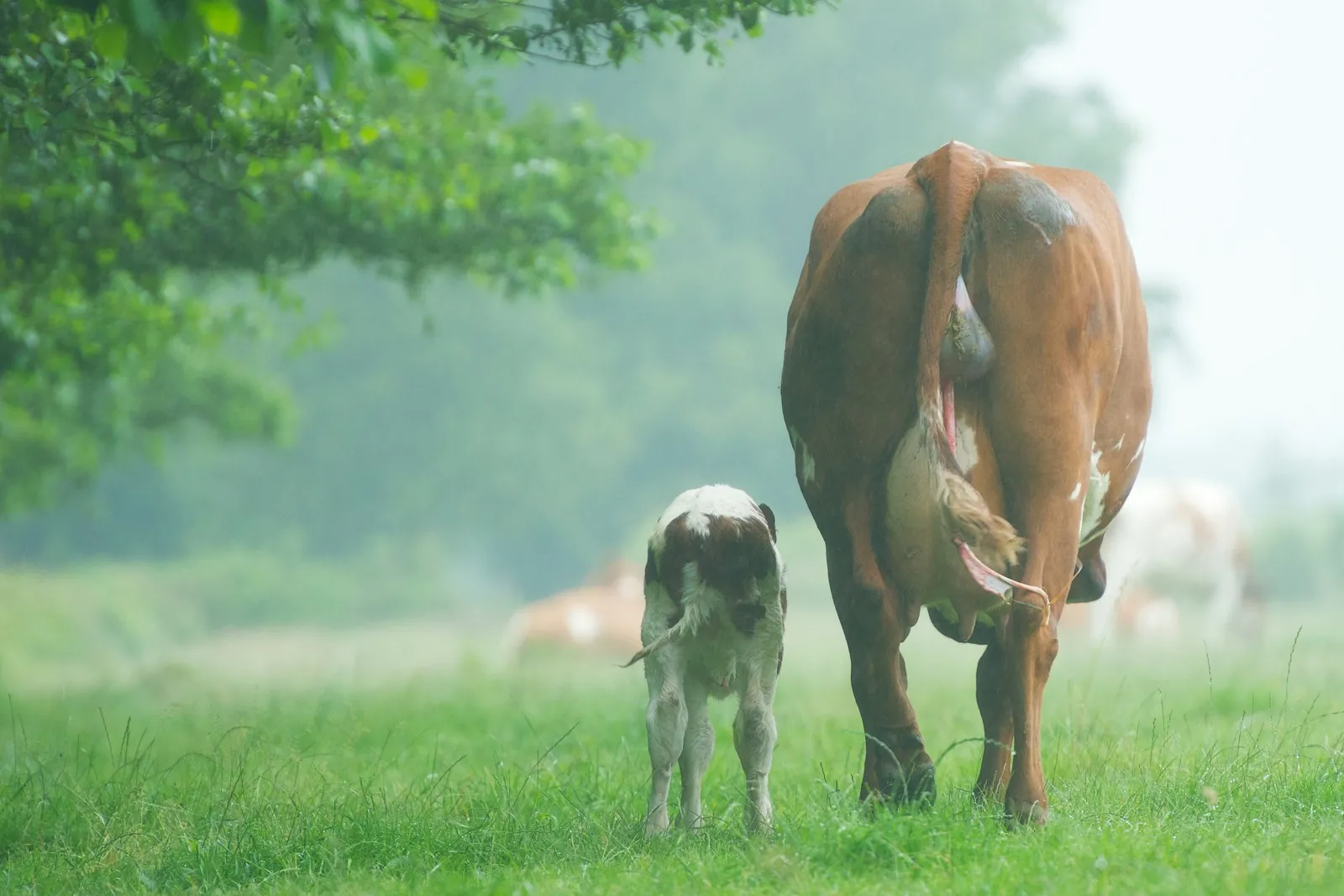
Cows are pregnant for about 9 to 9.5 months, which is roughly 282 to 290 days. A university extension guide gives an average cow gestation period of 282 days, while a 2025 Queensland study of 2,346 tropical breed pregnancies averaged 289.4 days, with Brahman calves carried longest at 291.5 days (Parish and Larson 2023; Moore, Johnston and Grant 2025).
How long are cows pregnant for?
Gestation length is the number of days from conception to the birth of the calf (Moore, Johnston and Grant 2025). Mississippi State University's calving guide uses an average of 282 days (Parish and Larson 2023). In the Australian Repronomics research herds in Queensland, where conception dates were known exactly from artificial insemination (AI), the average was 289.4 days and individual pregnancies ran from 271 to 305 days, a 34 day spread (Moore, Johnston and Grant 2025).
How long are cows pregnant in days, weeks and months?
Converting those averages (our arithmetic, using an average month of 30.44 days):
- 282 days is about 40 weeks, or 9.3 months.
- 289.4 days is about 41 weeks, or 9.5 months.
- 291.5 days (the Brahman average) is about 41.6 weeks, or 9.6 months.
What changes a cow's gestation length?
Breed: Bos indicus versus Bos taurus
Bos indicus cattle are the tropically adapted breeds such as Brahman; Bos taurus are the British and European breeds. In the Queensland study, adjusted breed averages were 291.5 days for Brahman, 288.2 days for Droughtmaster and 285.1 days for Santa Gertrudis calves (Moore, Johnston and Grant 2025).
The same paper summarises earlier Australian work on temperate breeds: averages of 280.8 to 284.8 days for British Bos taurus breeds and 286.1 to 288.7 days for European breeds. It also notes that tropical breeds have consistently been found to carry longer than temperate breeds (Moore, Johnston and Grant 2025). On these averages, a purebred Brahman herd would calve roughly 7 to 11 days later than a British breed herd joined on the same day (our arithmetic: 291.5 minus 284.8 is 6.7 days, and 291.5 minus 280.8 is 10.7 days).
Calf sex
Bull calves are carried longer. Males were carried 3.1 days longer in Brahmans, 2.4 days in Santa Gertrudis and 1.9 days in Droughtmasters (Moore, Johnston and Grant 2025).
The sire's genetics
Gestation length is strongly inherited. The Queensland study estimated a heritability of 0.79, and the spread between the shortest and longest Gestation Length EBVs among sires was 16.0 to 21.7 days within a breed (Moore, Johnston and Grant 2025). An EBV (estimated breeding value) predicts how a bull's calves will compare with other bulls' calves.
BREEDPLAN explains that shorter gestation is generally linked to lighter birth weight, easier calving and better rebreeding of the cow, and that a bull with a Gestation Length EBV of minus 2 days would be expected to sire calves born earlier, and more easily, than one at plus 2 days (BREEDPLAN n.d.). The Queensland study found a positive genetic link between gestation length and birth weight, but no significant link with weaning weight (Moore, Johnston and Grant 2025).
How long are cows pregnant with twins?
Shorter. In a United States herd selected for twinning, twins were carried 277.5 days on average against 284.3 days for single calves, 6.8 days less, and triplets 271.6 days. Twin births had more calving difficulty, and twins were lighter at birth (Echternkamp et al. 2007). If a cow calves a small calf, Agriculture Victoria suggests checking for a twin (Bowman n.d.).
Heifer versus cow
A heifer's first pregnancy is not reliably shorter. The Queensland researchers found that only calf sex and sire have consistently affected gestation length in the research literature, with factors such as cow age and number of previous calvings tending not to matter (Moore, Johnston and Grant 2025). Mississippi State does note that some cows, and especially heifers, may calve earlier than the 282 day average (Parish and Larson 2023), so watch heifers from early in the calving period. Heifers also need help more often: in US survey figures, 88.4 per cent of heifers calved with no assistance compared with 95.7 per cent of cows (Parish and Larson 2023).
Cow gestation calculator: how do you work out a calving date?
Add the average gestation length to the conception date. With natural mating you rarely know that date, so use the joining dates: first calves come about one gestation after the bulls go in, and the last about one gestation after they come out.
The table below is a quick cow gestation chart. It uses illustrative numbers: 282 days, the Mississippi State average (Parish and Larson 2023), which sits inside the 280.8 to 284.8 day range reported for British breeds (Moore, Johnston and Grant 2025), and 289 days for tropical breed cattle, rounded from the 289.4 day average (Moore, Johnston and Grant 2025). The dates are our arithmetic. If a pregnancy runs through 29 February in a leap year, the calving date is one day earlier.
| Conception or bull in date | Plus 282 days (British breeds) | Plus 289 days (tropical breeds) |
|---|---|---|
| 1 October | 10 July | 17 July |
| 1 November | 10 August | 17 August |
| 1 December | 9 September | 16 September |
| 1 January | 10 October | 17 October |
| 1 February | 10 November | 17 November |
| 1 March | 8 December | 15 December |
| 1 April | 8 January | 15 January |
Worked example (illustrative numbers)
- Bulls go in with British breed cows on 1 December and come out 12 weeks (84 days) later, on 23 February.
- First calves due: 1 December plus 282 days = about 9 September.
- Last calves due: 23 February plus 282 days = about 2 December.
- Pregnancy test: 8 to 10 weeks after the bulls come out (Agriculture Victoria 2024) = 20 April to 4 May.
Treat every calculated date as the middle of a window. Individual pregnancies in the Queensland herds varied by 34 days from shortest to longest (Moore, Johnston and Grant 2025), so start watching well before the first due date.
How does pregnancy testing and foetal ageing work?
Pregnancy testing is done by an experienced operator, such as a PREGCHECK accredited vet, feeling the uterus through the rectal wall (manual palpation) or using ultrasound. Agriculture Victoria says manual palpation can reliably detect pregnancy from as early as 6 weeks, and that cows found not pregnant by ultrasound should be confirmed by palpation (Agriculture Victoria 2024).
- When to test: normally 8 to 10 weeks after the end of mating. Heifers mated for a short 6 to 8 week period can be tested 8 weeks after the bulls come out (Agriculture Victoria 2024).
- Foetal ageing: both methods can estimate how far along the pregnancy is, but accuracy falls as the foetus gets older. Experienced operators are most accurate in the first 4 months (Agriculture Victoria 2024).
- How accurate: in an evaluation of 23 cattle vets reported in the appendices to MLA's CashCow project, foetal ageing by palpation was thought to be accurate within half a month before 5 months of pregnancy and within a month after that (Meat & Livestock Australia n.d.a).
A foetal age plus the remaining days of gestation gives a due date, so early and late calvers can be separated (Agriculture Victoria 2024). FutureBeef adds that the results help plan weaning, supplements and the management of cows due to calve in the late dry season, and that every animal should be tested, including cows that "look calfy" (Sullivan 2011).
What are the signs a cow is about to calve?
University of Nebraska extension describes the usual signs, from weeks out to the last day (Rasby 2024):
- Weeks before: the udder develops ("making bag") and the vulva relaxes and swells ("springing"). Both become more obvious in the last two weeks.
- Cervical plug: thick mucus hanging from the vulva. This can be seen weeks before calving, so it is not a sign of calving that day.
- Within about 24 hours: the pelvic ligaments relax, and the teats may fill and stand out ("strutting"). Ligament relaxation is easy to see in thin or moderate cows but hard to see in fat ones, and teat strutting is not dependable.
- Last 12 hours: some cows stop coming up to feed or go off by themselves, but many show few behaviour changes until labour starts.
Signs a heifer is about to calve
The signs are the same. A first calf heifer, particularly in the milking breeds, can develop an udder for two or three months before calving (Rasby 2024), so a bag alone does not mean calving is close. Heifers are more likely than cows to need help, and Mississippi State suggests checking calving females at least every 3 hours (Parish and Larson 2023).
What are the stages of calving, and when should you help?
Calving happens in three stages, which can run together in a normal birth (Bowman n.d.; Parish and Larson 2023).
- Stage 1, getting ready (about 2 to 6 hours): the cervix opens and contractions begin. The cow is restless, may walk the paddock, lie down and get up repeatedly or kick at the belly.
- Stage 2, delivery (about 30 to 60 minutes; heifers often longer): starts when the water bag appears and ends when the calf is out. The two front feet, soles down, should come first, followed by the head.
- Stage 3, cleaning: the afterbirth (placenta) is passed, generally within 6 to 24 hours. Do not pull it out by hand; call a vet if it is still retained 48 hours after calving (Parish and Larson 2023).
When to step in
Agriculture Victoria's guide says that once the water bag shows you can usually leave the cow undisturbed for about an hour, by which time two feet should be visible, and the calf should follow within about another hour, often less for a mature cow. As a rule, examine any cow that has not delivered within four hours of first showing signs of calving (Bowman n.d.). Mississippi State suggests about 2 hours of labour after the water bag appears, and stepping in sooner if 30 minutes pass with no progress (Parish and Larson 2023).
Check sooner if you see (Bowman n.d.):
- a cow that is very restless and will not settle to calve;
- no progress to the next stage for about an hour;
- only one foot, or one foot well ahead of the other;
- toes pointing downwards, which suggests a backwards (breech) calf and that help is most likely needed;
- hard straining with no calf visible.
Treat any calf coming backwards as an emergency, and call a vet if you cannot work out the calf's position, cannot correct it, the calf is too big, or delivery is not progressing (Parish and Larson 2023).
How much weight does pregnancy add to a cow?
A pregnant cow's liveweight is the cow's own body plus the pregnancy itself: the pregnant (gravid) uterus and the calf growing inside it. A Queensland study of 2,181 Brahman and tropical composite females concluded that "pregnancy adds weight to cows at all stages, rather than displacing weight", so subtracting the weight of the pregnancy gives a fair non pregnant weight (Fordyce et al. 2013).
That paper prints the equation it used for the expected weight of pregnancy, and charts it for a typical 500 kg cow. Putting days into that equation gives the figures below (our arithmetic, not values stated in the paper):
| Days pregnant | Extra weight |
|---|---|
| 90 days (about 3 months) | about 4 kg |
| 150 days (about 5 months) | about 10 kg |
| 180 days (about 6 months) | about 15 kg |
| 210 days (about 7 months) | about 23 kg |
| 240 days (about 8 months) | about 34 kg |
| 270 days (about 9 months) | about 49 kg |
Most of it goes on in the last three months, so some of a heavily pregnant cow's weight gain is the calf, not the cow. Our article on how much a cow weighs covers the other things that move liveweight, such as gut fill and condition. A weight estimate from a tape or a photo app such as CattleScale also sees the whole animal, pregnancy included, and is only an estimate: in its first test on 70 scale weighed cattle CattleScale's typical error was about 23 per cent, which on a 500 kg cow is about 115 kg, more than twice what a late pregnancy adds (our arithmetic). Use scales where the number matters.
Why does body condition at calving matter?
Condition at calving strongly affects how quickly a cow gets back in calf. Agriculture Victoria says the better the fat score cows calve down in, "the quicker they will return to oestrus", with a better chance of getting in calf within the joining period (Agriculture Victoria 2025). FutureBeef calls breeder body condition before calving "the major determinant of conception rates", with cows in condition score 3 and 4 conceiving sooner and at higher rates than those in score 2 (Sullivan 2011).
MLA's More Beef from Pastures condition score targets are no lower than 2.5 at calving for autumn calving cows and no lower than 2.0 at calving for spring calving cows, with cows drafted at weaning so thinner ones can be fed preferentially (Meat & Livestock Australia n.d.b). Condition and weight are linked: in the Queensland study, liveweight changed by 12 to 14 per cent for each condition score on a 5 point scale (Fordyce et al. 2013). See body condition scoring beef cattle for how to score.
Frequently asked questions
How long are cows pregnant for in months?
About 9 to 9.5 months. A 282 day average is about 9.3 months, and the 289.4 day average for tropical breeds in a Queensland study is about 9.5 months. Brahman cattle averaged 291.5 days, close to 9.6 months.
How long are cows pregnant in days?
Usually about 282 to 290 days on average. In the Queensland study individual pregnancies ranged from 271 to 305 days, so plan around a calving window, not a single date.
How long are cows pregnant with twins?
Shorter than with one calf. In a US twinning herd, twins were carried 277.5 days on average against 284.3 days for singles, about a week less. Twin births also had more calving difficulty.
Are Brahman cows pregnant longer than other breeds?
Yes. Brahman calves averaged 291.5 days in a Queensland study, while earlier Australian work found British breed averages of 280.8 to 284.8 days. That is roughly 7 to 11 days later from the same joining date.
What are the signs a cow is about to calve?
Weeks out, the udder fills and the vulva swells. Within about 24 hours the pelvic ligaments relax and the teats may fill. In labour the cow is restless, then the water bag appears; examine any cow that has not calved within about four hours of starting.
References
- Agriculture Victoria (2024) 'Pregnancy testing of beef cattle', Agriculture Victoria. Available at: https://agriculture.vic.gov.au/livestock-and-animals/beef/breeding/pregnancy-testing-of-beef-cattle (Accessed: 5 October 2026).
- Agriculture Victoria (2025) 'Chapter 4: Monitoring stock condition', Drought feeding and management of beef cattle. Melbourne: Agriculture Victoria. Available at: https://www.feedinglivestock.vic.gov.au/wp-content/uploads/2025/06/CS-1717-Drought-Feeding-and-Management-of-Beef-Cattle_V4_Chapter-4.pdf (Accessed: 5 October 2026).
- Bowman, J. (n.d.) 'Managing dystocia in beef cows', Newsflash, Agriculture Victoria. Available at: https://agriculture.vic.gov.au/support-and-resources/newsletters/newsflash/managing-dystocia-in-beef-cows/Managing_Dystocia_in_Beef_Cows.pdf (Accessed: 5 October 2026).
- BREEDPLAN (n.d.) 'Understanding Gestation Length EBVs', BREEDPLAN Help Centre, Agricultural Business Research Institute. Available at: https://breedplan.une.edu.au/understanding-ebvs/understanding-gestation-length-ebvs/ (Accessed: 5 October 2026).
- Echternkamp, S.E., Thallman, R.M., Cushman, R.A., Allan, M.F. and Gregory, K.E. (2007) 'Increased calf production in cattle selected for twin ovulations', Journal of Animal Science, 85(12), pp. 3239 to 3248. Available at: https://doi.org/10.2527/jas.2007-0210 (Accessed: 5 October 2026).
- Fordyce, G., Anderson, A., McCosker, K., Williams, P.J., Holroyd, R.G., Corbet, N.J. and Sullivan, M.S. (2013) 'Liveweight prediction from hip height, condition score, fetal age and breed in tropical female cattle', Animal Production Science, 53(4), pp. 275 to 282. Available at: https://doi.org/10.1071/AN12253 (Accessed: 5 October 2026).
- Meat & Livestock Australia (n.d.a) CashCow final report: appendices. Sydney: Meat & Livestock Australia. Available at: https://www.mla.com.au/globalassets/mla-corporate/news-and-events/documents/cash-cow-final-report-appendices.pdf (Accessed: 5 October 2026).
- Meat & Livestock Australia (n.d.b) '5.02: Condition scoring beef cattle', More Beef from Pastures, Meat & Livestock Australia. Available at: https://mbfp.mla.com.au/weaner-throughput/tool-52-condition-scoring-beef-cattle/ (Accessed: 5 October 2026).
- Moore, K.L., Johnston, D.J. and Grant, T.P. (2025) 'Gestation length is highly heritable and could indirectly reduce birthweight without impacting the weaning weight of Australian tropically adapted Bos indicus beef cattle', Animal Production Science, 65(18), AN25246. Available at: https://doi.org/10.1071/AN25246 (Accessed: 5 October 2026).
- Parish, J.A. and Larson, J.E. (2023) 'Providing assistance at calving', Publication 2675, Mississippi State University Extension Service. Available at: https://extension.msstate.edu/publications/providing-assistance-calving (Accessed: 5 October 2026).
- Rasby, R. (2024) 'Know the signs of impending calving in cows or heifers', UNL Beef, University of Nebraska-Lincoln. Available at: https://beef.unl.edu/cattleproduction/impending2008 (Accessed: 5 October 2026).
- Sullivan, M. (2011) 'Pregnancy testing: using results', FutureBeef. Available at: https://futurebeef.com.au/resources/pregnancy-testing/ (Accessed: 5 October 2026).