 CattleScale
Dressing percentage in cattle: formula, typical ranges and how to estimate carcase weight
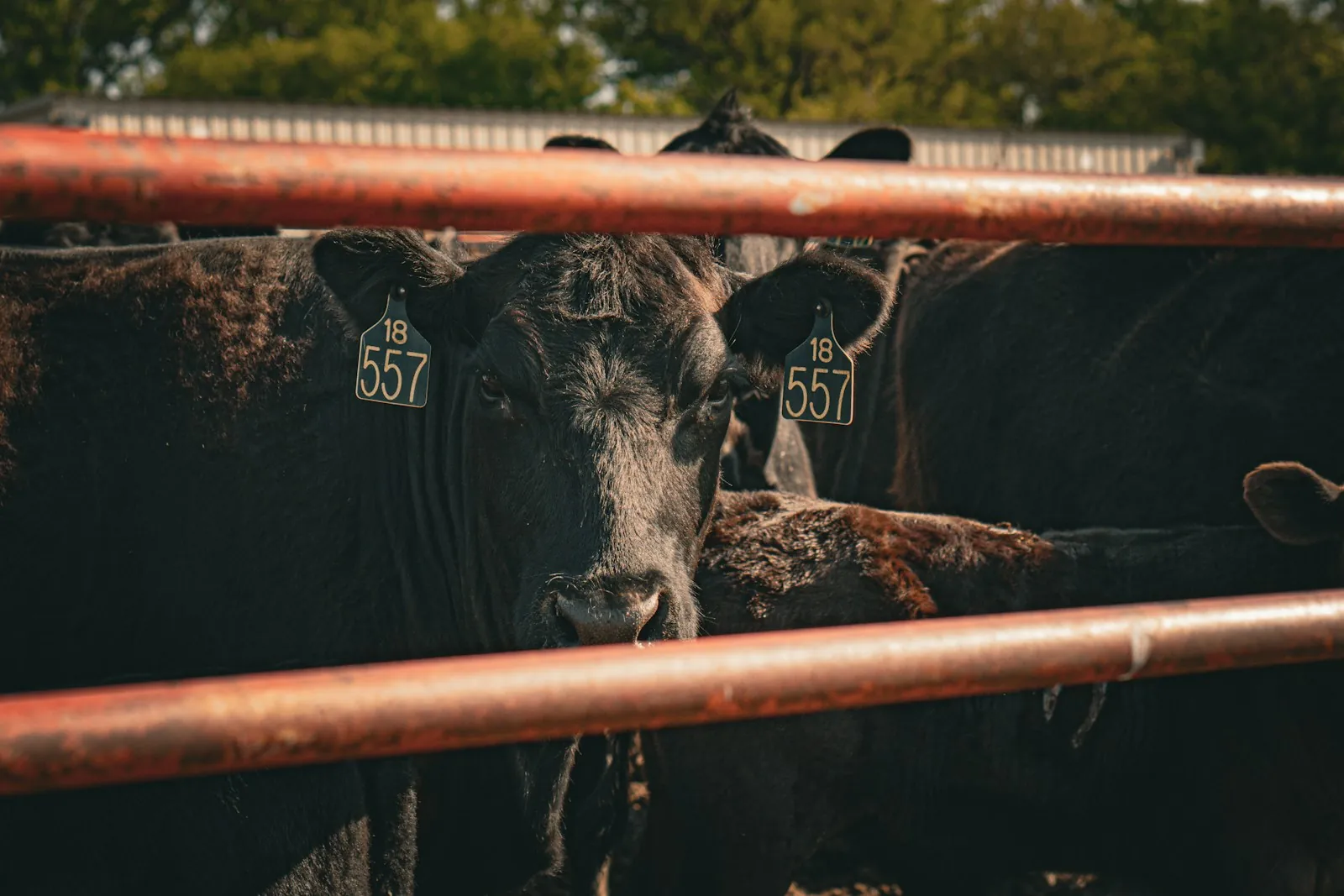
Dressing percentage is carcase weight divided by liveweight, times 100. The NSW Department of Primary Industries (NSW DPI) guide lists 48 to 59 per cent for vealers, young cattle and heavy steers, the leanest light cows sit at 38 to 40, and Meat & Livestock Australia (MLA) puts the usual range at 38 to 60 per cent, depending on condition, sex and breed (McKiernan, Gaden and Sundstrom 2007; MLA n.d.).
What does dressing percentage of cattle mean?
Dressing percentage is "simply carcase weight as a percentage of liveweight". It is used to estimate carcase weight from a known or estimated liveweight, and to compare a liveweight price with a carcase price (McKiernan, Gaden and Sundstrom 2007). It is also called dressing out percentage, and the term "yield" is often used instead, which is not the same as saleable meat yield (MLA 2021).
The carcase is what is left once the hide, feet, tail, head and innards are removed (MLA 2021). Gut contents, hide and mud count in liveweight but never reach the hook, which is why one beast can dress differently on different days. See also why knowing your cattle's liveweight matters.
What is the dressing percentage of cattle formula?
The NSW DPI Primefact gives the two working formulas (McKiernan, Gaden and Sundstrom 2007):
- Dressing percentage = (carcase weight ÷ liveweight) × 100
- Carcase weight = liveweight × dressing percentage
Its example: a 400 kg steer weighed full gives a 208 kg carcase, so 52 per cent. Weighed after an overnight curfew at 380 kg, the same carcase gives 54.7 per cent (McKiernan, Gaden and Sundstrom 2007).
What is hot standard carcase weight (HSCW)?
Hot standard carcase weight is the "hot weight of AUS-MEAT Standard Trim Carcase" (FutureBeef 2011b). The NSW DPI guide describes the AUS-MEAT standard carcase as the hot weight with kidney fats and channel fats out, and notes that most abattoirs use HSCW in line with AUS-MEAT standards (McKiernan, Gaden and Sundstrom 2007).
Two variations change the number:
- Fats in. Some buyers use the standard domestic carcase with kidney and channel fats left in. That carcase weighs about 3 per cent more on average, raising dressing percentage by about 1.5 units, and by 2 to 3 units in heavier, fatter cattle (McKiernan, Gaden and Sundstrom 2007).
- Cold weight. Where an abattoir trades on cold weight, around 3 per cent is usually deducted from the hot weight, with the actual figure ranging from 2 to 4 per cent (FutureBeef 2011a).
What is hanging weight of a cow or beef animal?
"Hanging weight" is the North American term. University of Maine Extension defines hot carcass weight as the freshly slaughtered carcass, "also referred to as hanging weight", and cold carcass weight as the carcass after cooling (Knight 2020).
The trim is not identical, though. The Government of Alberta notes that the US carcass weight includes the kidney, pelvic and heart fat, and that this makes US dressing percentages 2.5 to 3.0 per cent higher than for equivalent cattle in Canada (Government of Alberta n.d.). Australian HSCW takes kidney and channel fats out (McKiernan, Gaden and Sundstrom 2007). Our reading: a US hanging weight and an Australian HSCW from the same animal will differ, so do not use US dressing figures for Australian over the hooks sales.
University of Maine Extension puts US finished cattle at 58 to 64 per cent and cull cows at "about 50%", with 3 to 5 per cent cooler shrink (Knight 2020). University of Wisconsin Extension lists 62 to 64 per cent for grain finished steers (Cauffman et al. n.d.).
What is a typical dressing percentage for beef cattle?
The NSW DPI guide gives dressing percentages based on HSCW by class and by P8 fat depth (fat measured over the rump in millimetres). Its table is headed "approx 2 hours off pasture". Be aware the Primefact is not consistent on this: its introduction says its guidelines are for saleyard liveweights after a 12 hour curfew, which is 15 to 18 hours from muster to weighing (McKiernan, Gaden and Sundstrom 2007). Treat the weighing basis of the table as uncertain and check it against your own carcase feedback. NSW DPI suggests using the lower figure for cattle of muscle score D, the upper figure for muscle score B, and the midpoint for muscle score C (McKiernan, Gaden and Sundstrom 2007). If muscle scores are new to you, see frame score and muscle score in beef cattle.
| P8 fat depth | Vealers and yearlings | Young cattle, steers and heifers | Heavy steers | Cows, heaviest class (over 250 kg) |
|---|---|---|---|---|
| 0 to 2 mm | 49 to 50 | 50 to 53 | 48 to 52 | 42 to 45 |
| 7 to 9 mm | 51 to 55 | 52 to 55 | 51 to 54 | 44 to 48 |
| 13 to 15 mm | 53 to 57 | 54 to 57 | 53 to 56 | 49 to 51 |
| 20 mm and over | not listed | 56 to 59 | 55 to 58 | 51 to 56 |
The same guide lists lighter cow classes lower still, starting at 38 to 40 per cent for the leanest cows in its under 200 kg class, and bulls at 48 to 58 per cent depending on weight. The figures assume average British breed cattle (McKiernan, Gaden and Sundstrom 2007).
A peer reviewed Irish study of 18,479 young cattle and 2,887 cows found mean dressing percentages of 55.86 per cent in young animals and 49 per cent in cows (Coyne, Evans and Berry 2019). Irish carcase rules differ from AUS-MEAT, so treat that as a pattern, not a benchmark.
What changes dressing percentage?
Anything that changes liveweight (such as gut fill) or carcase weight (such as bruising or shrink) changes dressing percentage (McKiernan, Gaden and Sundstrom 2007).
Gut fill and curfew
Cattle lose weight fastest in the first 12 to 16 hours off feed and water. For cattle off average quality green temperate pasture, NSW DPI expects (McKiernan, Gaden and Sundstrom 2007):
| Time off feed and water | Liveweight loss | Increase in dressing percentage |
|---|---|---|
| 1 hour | 1.5% | 0.75% |
| 2 hours | 2.5% | 1.25% |
| 4 hours | 4% | 2% |
| 12 hours | 7% | 3.5% |
| 16 hours | 8% | 4+% |
Sixteen hours is a standard dry overnight saleyard curfew. Cattle with water but no feed (a wet curfew) lose about two thirds as much, around 6 per cent after 16 hours. Prolonged trucking can take another 2 per cent, and losses are faster in hot weather (McKiernan, Gaden and Sundstrom 2007). Gut fill upsets average daily gain figures the same way.
Water matters for the carcase itself. In an Australian study, bullocks given water for the 26 hours before slaughter had heavier carcases than those denied water, 331 kg against 312 kg (Wythes et al. 1983). Sources differ on when carcase loss starts: after 12 hours without water and 24 hours without feed, says MLA (MLA 2021), or beyond 48 to 72 hours off feed, says NSW DPI (McKiernan, Gaden and Sundstrom 2007).
Grass versus grain finish
Cattle on roughage carry more gut fill and less carcase fat (Government of Alberta n.d.). With steers of equal fatness weighed full, NSW DPI says a feedlot steer may dress 2 to 4 per cent heavier than a crop fattened steer, but only about 1 per cent heavier once both have emptied out (McKiernan, Gaden and Sundstrom 2007).
A Californian study recorded 61.8 per cent for feedlot finished steers, 57.5 per cent for grass fed steers with a 45 day grain finish, and 53.4 and 50.3 per cent for steers grass fed for 25 and 20 months (Klopatek et al. 2022).
Fat and muscle
Fatter cattle tend to dress higher, but their saleable meat yield is lower because of extra trimming. Heavier muscled cattle also dress higher: within a breed, NSW DPI allows 1 to 1.5 units per unit increase in muscle score (McKiernan, Gaden and Sundstrom 2007).
Breed
NSW DPI adds 1 to 2 per cent for cattle with 50 per cent or more Bos indicus content, partly because of lighter gut contents, and 1 to 3 per cent where European content gives heavy muscling. Dairy breeds dress on average 1 per cent below British beef breeds (McKiernan, Gaden and Sundstrom 2007).
Sex and pregnancy
Heifers usually dress 1.5 to 2.0 percentage points below steers at a similar fat level, and steers below bulls (Government of Alberta n.d.). The Irish study found the same order in its model for purebred Limousin cattle: 59.24 per cent for bulls, 57.30 per cent for steers and 56.09 per cent for heifers (Coyne, Evans and Berry 2019).
Pregnancy lowers dressing percentage, most in light cows. Compared with empty cows, cows 3 to 6 months pregnant dress 2 to 5 per cent less, and cows 6 to 9 months pregnant 5 to 10 per cent less (McKiernan, Gaden and Sundstrom 2007).
Hide, coat and dirt
The hide comes off at slaughter, so mud and hair are liveweight that never reaches the carcase. A dirty hide lowers dressing percentage (Cauffman et al. n.d.). In Alberta, dressing percentages start falling in September as hair coats thicken and tag builds up, and are lowest in December and January, and breeds with a heavier hide, head, feet and viscera dress lower (Government of Alberta n.d.).
Trim, bruising and country
Bruise trim cuts carcase weight, and over the hooks sellers are not paid for bruise trim (McKiernan, Gaden and Sundstrom 2007; FutureBeef 2011a). Cattle bred and fattened on fertile country generally dress 1 to 2 per cent higher than cattle only recently moved onto it (McKiernan, Gaden and Sundstrom 2007).
Dressing percentage of cattle calculator: a worked example
These are illustrative numbers to show the arithmetic. They are not research results. The percentages come from the NSW DPI guide (McKiernan, Gaden and Sundstrom 2007); the sums are our arithmetic.
A young steer weighs 450 kg about 2 hours off pasture. Its P8 fat depth is 7 to 9 mm and it is muscle score C. The guide gives young cattle at that fat depth 52 to 55 per cent, so muscle score C takes the midpoint, 53.5 per cent.
Estimated HSCW: 450 × 0.535 = 240.75, about 240.8 kg. Each 1 per cent of dressing percentage on this steer is 4.5 kg of carcase.
| Assumption | Dressing % | Carcase weight | Working |
|---|---|---|---|
| Muscle score C, HSCW | 53.5% | 240.8 kg | 450 × 0.535 |
| Muscle score B (top of range) | 55% | 247.5 kg | 450 × 0.55 |
| Muscle score D (bottom of range) | 52% | 234.0 kg | 450 × 0.52 |
| Muscle score C, works deducts 3% for cold weight | 51.9% | 233.5 kg | 240.75 × 0.97 = 233.5; 233.5 ÷ 450 × 100 |
| Muscle score C, fats in (add about 1.5 units, the guide's average for fats in) | 55% | 247.5 kg | 450 × 0.55 |
Muscle score D to B alone spans 247.5 minus 234.0 = 13.5 kg of carcase.
Working back from a carcase target (liveweight to carcase weight in reverse)
If a processor wants a 260 kg HSCW and you expect 53.5 per cent, the steer needs to weigh about 260 ÷ 0.535 = 486 kg on the same weighing basis (our arithmetic). That is about 36 kg more than our example steer. For typical liveweights by age and breed, see how much does a cow weigh.
One trap: the table is headed about 2 hours off pasture, though the Primefact's introduction says 12 hour curfew saleyard weights (see above). For saleyard weights, where stock are off feed much longer, NSW DPI suggests adding 2 per cent (McKiernan, Gaden and Sundstrom 2007). Weigh with the same timing every time.
Why does dressing percentage matter when selling over the hooks or on liveweight?
Over the hooks means selling directly to a processor on a cents per kilogram carcase weight basis (MLA n.d.). The trim and hot or cold weight used both affect payment (FutureBeef 2011a). Many larger saleyards, and paddock sales by weight, sell on liveweight instead (FutureBeef 2011a).
Dressing percentage is the bridge between the two. Because carcase weight equals liveweight times dressing percentage, a carcase price multiplied by your expected dressing percentage gives a comparable liveweight figure (our arithmetic). That price comparison is exactly what NSW DPI says dressing percentage is for (McKiernan, Gaden and Sundstrom 2007).
A higher dressing percentage is not automatically better. The Government of Alberta gives an example where a fatter carcase dressed 1.5 per cent higher but could return less because over fat carcases are discounted (Government of Alberta n.d.). Check the grid, not just the yield.
Producers selling over the hooks to AUS-MEAT accredited abattoirs get carcase feedback (FutureBeef 2011b). Divide each HSCW by your own on farm weight to build a dressing percentage history for your cattle.
How does knowing liveweight before sale help?
Every carcase estimate starts with liveweight, so an error there flows straight through. MLA's market assessors are held to a competency standard of within 7 per cent for liveweight, within 3 per cent for dressing percentage and within 12 kg for carcase weight, for 70 per cent of animals (MLA 2021). Guessing both by eye stacks two errors.
A scale removes the first error. Weigh a sample of the mob at a set time off feed a few weeks before sale, then:
- multiply by the dressing percentage for their class, fat and muscle to estimate HSCW;
- check the estimate against the processor's carcase weight range, and hold back any that are under;
- compare an over the hooks quote with a liveweight option on the same footing;
Where scales are far off, a photo estimate gives a rough first look. CattleScale estimates liveweight from photos and shows a range with a Low, Moderate or Good confidence rating. In its first test on 70 scale weighed cattle, the typical error was about 23 per cent, and the true weight fell inside the shown range about four times in ten. It is an estimate, not a weigh scale. When a few kilograms of carcase matter, weigh the cattle.
Frequently asked questions
What is a good dressing percentage for beef cattle?
For Australian young cattle and steers with moderate fat, NSW DPI's guide gives about 51 to 55 per cent on a hot standard carcase weight basis, rising to 55 to 59 per cent in very fat cattle. Lean cows can be below 45 per cent. MLA puts the usual range at 38 to 60 per cent.
How do you calculate dressing out percentage in cattle?
Divide carcase weight by liveweight and multiply by 100. A 208 kg carcase from a 400 kg steer is 52 per cent. To go the other way, carcase weight equals liveweight times dressing percentage.
Is hanging weight the same as hot standard carcase weight?
Close, but not identical. Hanging weight is the North American term for hot carcass weight. Australian HSCW is the hot weight of the AUS-MEAT standard trim carcase with kidney and channel fats removed, while the US carcass includes kidney, pelvic and heart fat.
How much does gut fill change dressing percentage?
A lot. NSW DPI expects cattle off green pasture to lose about 7 per cent of liveweight in 12 hours and 8 per cent in 16 hours off feed and water, lifting dressing percentage by roughly 3.5 to 4 units. Weigh at the same time off feed every time.
Do grass fed cattle dress lower than grain fed cattle?
Usually. Grass fed cattle carry more gut fill and less fat. NSW DPI says a feedlot steer weighed full may dress 2 to 4 per cent heavier than a crop fattened steer, but only about 1 per cent once both are emptied out.
References
- Cauffman, A., Olson, A., Ihde, C. and Halfman, B. (n.d.) 'How much meat should a beef animal yield?', University of Wisconsin-Madison Division of Extension. Available at: https://livestock.extension.wisc.edu/files/2020/09/Beef-animal-yield.pdf (Accessed: 5 October 2026).
- Coyne, J.M., Evans, R.D. and Berry, D.P. (2019) 'Dressing percentage and the differential between live weight and carcass weight in cattle are influenced by both genetic and non-genetic factors', Journal of Animal Science, 97(4), pp. 1501 to 1512. Available at: https://doi.org/10.1093/jas/skz056 (Accessed: 5 October 2026).
- FutureBeef (2011a) 'Selling options for beef cattle', FutureBeef. Available at: https://futurebeef.com.au/resources/selling-options-for-beef-cattle/ (Accessed: 5 October 2026).
- FutureBeef (2011b) 'The AUS-MEAT language', FutureBeef. Available at: https://futurebeef.com.au/resources/the-aus-meat-language/ (Accessed: 5 October 2026).
- Government of Alberta (n.d.) 'Understanding dressing percentage of slaughter cattle', Agricultural Marketing Guide, Government of Alberta. Available at: https://www.alberta.ca/understanding-dressing-percentage-of-slaughter-cattle (Accessed: 5 October 2026).
- Klopatek, S.C., Marvinney, E., Duarte, T., Kendall, A., Yang, X.C. and Oltjen, J.W. (2022) 'Grass-fed vs. grain-fed beef systems: performance, economic, and environmental trade-offs', Journal of Animal Science, 100(2), skab374. Available at: https://doi.org/10.1093/jas/skab374 (Accessed: 5 October 2026).
- Knight, C.W. (2020) 'Bulletin #1071, What to expect when buying a freezer beef', University of Maine Cooperative Extension. Available at: https://extension.umaine.edu/publications/1071e/ (Accessed: 5 October 2026).
- McKiernan, B., Gaden, B. and Sundstrom, B. (2007) 'Dressing percentages for cattle', Primefact 340, NSW Department of Primary Industries. Available at: https://www.dpird.nsw.gov.au/__data/assets/pdf_file/0006/103992/dressing-percentages-for-cattle.pdf (Accessed: 5 October 2026).
- Meat & Livestock Australia (2021) 'Cattle assessment manual', Market Information Services, Meat & Livestock Australia. Available at: https://www.mla.com.au/globalassets/mla-corporate/extensions-training-and-tools/documents/assessmentmanual-cattle.pdf (Accessed: 5 October 2026).
- Meat & Livestock Australia (n.d.) 'Market information frequently asked questions', Meat & Livestock Australia. Available at: https://www.mla.com.au/prices-markets/faqs/ (Accessed: 5 October 2026).
- Wythes, J.R., Brown, M.J., Shorthose, W.R. and Clarke, M.R. (1983) 'Effect of method of sale and various water regimens at saleyards on the liveweight, carcass traits and muscle properties of cattle', Australian Journal of Experimental Agriculture and Animal Husbandry, 23(122), pp. 235 to 242. Available at: https://doi.org/10.1071/EA9830235 (Accessed: 5 October 2026).