 CattleScale
Frame score and muscle score in beef cattle, explained
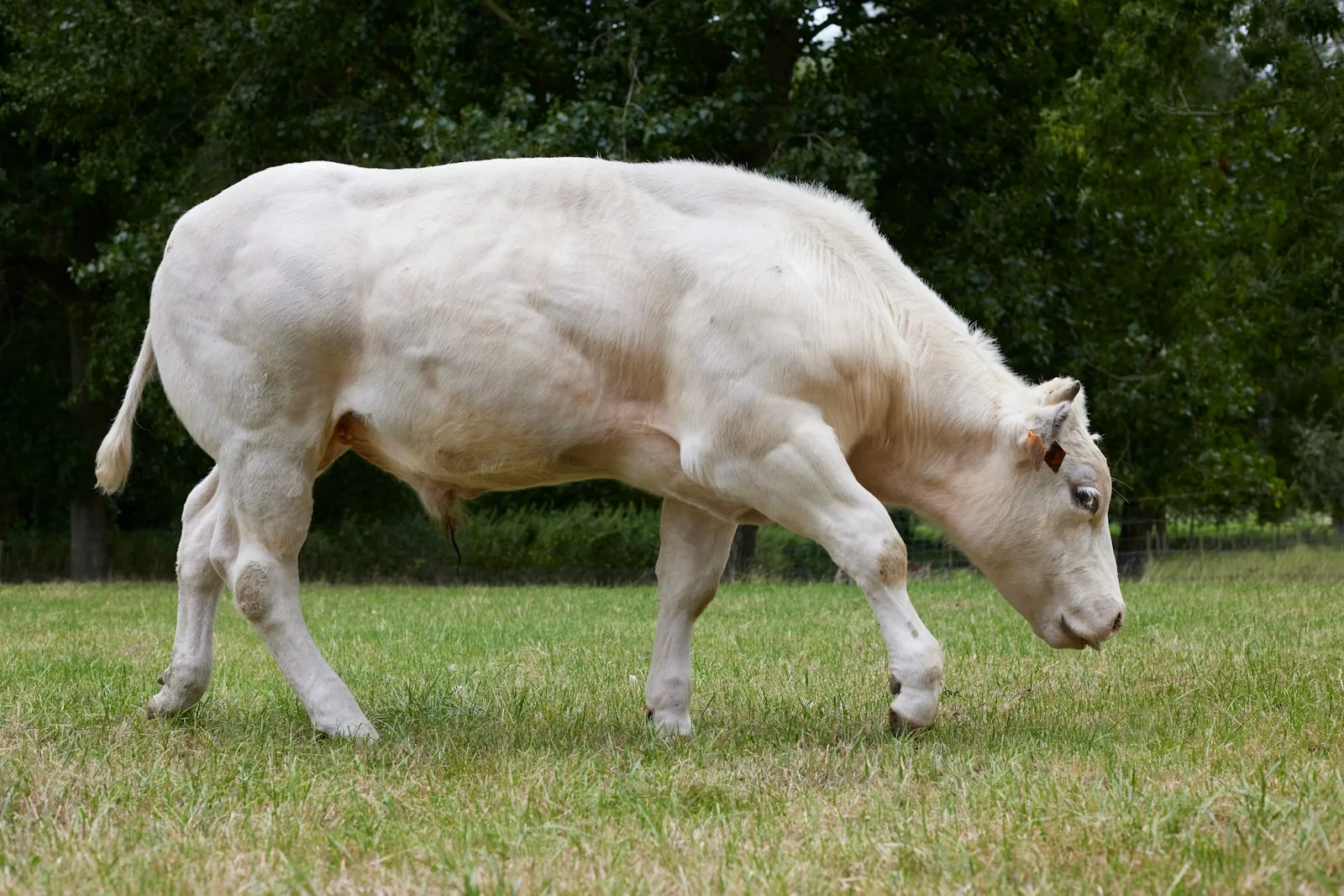
Frame score is a number for skeletal size: hip height measured at a known age, read off a chart, on a scale that runs from 1 (small, early maturing) to 11 (extreme, very late maturing). Muscle score is a visual grade of muscling, from A (very heavy) to E (light), judged mostly from behind and after allowing for fat. Neither one measures how fat an animal is, and neither is a breeding value.
What is frame score in beef cattle?
Frame score is "a convenient way of describing the skeletal size of cattle", based on height over the hips at a given age (McKiernan 2005). The national livestock language defines frame size as "a numerical score based on age and height where age is known in months and height is measured above the hook joints" (AUS-MEAT 2022).
Most animals keep the same frame score for life while their height keeps increasing, so one score describes the animal whenever it was measured. Poor nutrition can hold an animal below the height its genetics allow (McKiernan 2005).
How do you measure frame score?
- Hip height. Measure from level ground to the backbone above the line of the two hook joints, in whole centimetres. In a crush, take the crush height and subtract the gap down to the backbone (AUS-MEAT 2022).
- Age in months. Find the age row on the chart, find the height along it, and read the frame score at the top of that column (AUS-MEAT 2022).
Use the female chart for heifers and cows, which are about 5 cm shorter than bulls from 12 months on (McKiernan 2005). US charts based on Beef Improvement Federation guidelines work the same way, in inches (Van Emon n.d.). Common errors are measuring the wrong spot, uneven ground, and straight hocks or stifles, which add height without changing how the animal matures (McKiernan 2005). If you are unsure of age, our guide to telling cattle age by their teeth covers the basics.
What do the frame score ranges mean?
Australian charts score frame from 1 to 11. Most British breeds fall between 1 and 7, and most continental breeds between 4 and 9. Frames 10 and 11 are extreme sizes, and a score of 11 "is not to be interpreted as the best", it simply means the largest type (McKiernan 2005).
| Frame score | Maturity type | Carcase weight at market potential | Mature cow weight at fat score 3 | Hip height, 12 month bull | Hip height, 12 month heifer |
|---|---|---|---|---|---|
| 1 and 2 | Early maturing, small framed | 150 to 180 kg | Under 450 kg | 104 to 109 cm | 99 to 104 cm |
| 3, 4 and 5 | Moderate maturing, average framed | 200 to 350 kg | 450 to 600 kg | 114 to 124 cm | 109 to 119 cm |
| 6, 7 and 8 | Late maturing, large framed | 350 to 450 kg | Over 600 kg | 130 to 140 cm | 124 to 135 cm |
| 9, 10 and 11 | Very late maturing, extreme framed | Doubtful to reach enough fat for any quality market | Not stated | 145 to 155 cm | 140 to 150 cm |
Why does frame score matter?
Frame tells you when an animal is likely to finish. Small framed cattle reach the point where growth slows and fattening begins at a younger age and lighter weight. Large framed cattle keep growing longer before they fatten (McKiernan 2005).
- Matching cattle to markets. Domestic demand is mostly for light carcases of 180 to 230 kg. For feeder steers, NSW DPI suggests frame 3 to 5 for the domestic trade (70 to 100 days on feed), 4 to 6 for Japan short fed (100 to 150 days) and 5 to 7 for Japan long fed (220 to 300 days) (McKiernan 2005).
- Choosing bulls. If your sale cattle get too fat before reaching the weight you want, larger framed, later maturing bulls can "stretch out" the progeny (McKiernan 2005).
No single frame suits everyone: economic return should decide the right size for your feed, breeding system and market (McKiernan 2005).
Is frame score still reliable?
Treat it as a guide. NSW DPI notes that frame score "has no direct relationship with reproductive performance, growth rate or carcase quality", and that people have often used it to indicate weight "when it would be far more sensible just to weigh the animal" (McKiernan 2005). The standards are also almost 50 years old, and ABRI data show the average cow in one British breed was 85 kg heavier in 2021 than in 1996. EBVs from BREEDPLAN predict weight and mature size better (Rayner 2024).
What is muscle score in beef cattle?
Muscle score "describes the shape of cattle independent of the influence of fatness". It is "the degree of thickness or convexity of an animal relative to its frame size, after adjustments have been made for subcutaneous fat" (McKiernan 2007).
There are five scores, A to E. Adding a plus and minus to each turns it into a 15 point scale, A+ to E- (McKiernan 2007; BREEDPLAN n.d.). In short (McKiernan 2007):
- A, very heavy muscling. Extremely thick through the stifle, visible seams between muscles, "apple bummed" from the side.
- B, heavy muscling. Thick stifle, rounded thigh from behind, flat and wide over the top line.
- C, medium muscling. Flat down the thigh from behind, flat to angular over the top line.
- D, moderate muscling. Narrow stance, thin through the stifle, angular over the top line.
- E, light muscling. Dairy type, virtually no thickness through the stifle, feet together.
Most British and Bos indicus slaughter steers sit around C, and A+ is reserved for double muscled cattle (McKiernan 2007).
How do you assess muscle score?
Stand behind the animal. The indicators, in order of importance, are the thickness and roundness of the hindquarter, then stifle thickness and width in the twist, then width across the back and loin (McKiernan 2007).
- A well muscled animal is thicker through the stifle than over the top and stands with its hind legs wider apart. A fat, less muscular one is widest over the top and flat through the stifle (McKiernan 2007; BREEDPLAN n.d.).
- Score fat first, then allow for it. Muscle score is most accurate once fat score is known (AUS-MEAT 2022; McKiernan 2007).
For recording bulls, BREEDPLAN suggests scoring in good condition at 400 to 600 days old, with one person scoring the whole group on the day (BREEDPLAN n.d.).
Why does muscle score matter?
Muscling is linked to more saleable meat. In a study of 156 steers, a change in live muscle score from C to B, at the same liveweight and fat depth, came with 1.7 per cent more saleable meat as a share of carcase weight (Perry, Yeates and McKiernan 1993). Better muscled cattle also tend to dress higher (BREEDPLAN n.d.), and analysis of NSW and Victorian saleyard reports found a price premium for better muscled cattle and a clearer discount for poorly muscled ones (McKiernan 2007).
How are frame and muscle different from body condition?
Frame is bone and height. Muscle score is shape from muscle. Fat score and body condition describe fat cover. The national guidelines score fat and muscle separately, each "without any assessment" of the other (AUS-MEAT 2022).
The trap is that fat can look like muscle. "Muscle bulges and is round, fat wobbles, shrouds and flattens shape" (McKiernan 2007). A fat steer looks wide over the back but flat through the stifle; a lean, well muscled one shows rounded hindquarters and visible seams. Frame does not decide muscling either: small framed cattle can still be well muscled (McKiernan 2005).
An animal can be frame 6, muscle C and fat score 2 at once, and each number tells a buyer something different. For more on fat cover, see our guide to body condition scoring beef cattle.
How do buyers and sale catalogues use these scores?
- Market reports. The National Livestock Reporting Service quotes muscle score then fat score, so "C3" means muscle C, fat 3 (AUS-MEAT 2022). MLA asks its reporters to explain price differences with emphasis on these scores (Meat & Livestock Australia 2021).
- Online listings. AuctionsPlus assessors describe frame as Very Large, Large, Medium or Small, relative to breed and age (AuctionsPlus 2019).
- Bull catalogues. Muscle score describes breeding bulls (AUS-MEAT 2022), but it is not currently in the BREEDPLAN analysis, so it sits beside the EBVs, not inside them (BREEDPLAN n.d.).
Visual scoring is a skill. MLA's standard for its market reporters is that 70 per cent of muscle scores fall within one grade of the actual score (Meat & Livestock Australia 2021).
Where does CattleScale fit?
CattleScale reads a side on photo and returns an estimated liveweight with a range and a Low, Moderate or Good confidence rating. Alongside it, the app gives a body condition score on the 1 to 9 beef scale, an AUS-MEAT muscle score from A to E, a frame score from 0 to 9 based on hip height against age, an approximate age and an indicative value from MLA indicators.
These are photo estimates. Muscle score is judged from the stifle and round seen from behind, and left blank when no view supports it. Frame score is left blank when height or age is unclear, and its 0 to 9 scale is shorter than the 1 to 11 charts, so read it as a rough band, not a crush measurement. As the app says, "This is what it looks like, not what it will breed. Breeding values come from BREEDPLAN."
On weight, our first test on 70 scale-weighed cattle gave a typical error of about 23 per cent, with the true weight inside the range about four times in ten. A newer model, re-run on all 72 of those cattle in October 2026, did no better at about 23 per cent, so without a measured scale the app now shows a wider range, from 25 per cent under its estimate to 50 per cent over, which held the true weight about eight times in ten on that test. Details are in our accuracy FAQ. It is an estimate, not a weigh scale: do not dose, buy or sell on it.
Frequently asked questions
What is a good frame score for beef cattle?
There is no single best score. Pick the frame that suits your feed and market. For feeder steers, NSW DPI suggests frame 3 to 5 for the domestic trade and 4 to 6 or 5 to 7 for Japanese markets.
What does C3 mean in a cattle market report?
Muscle score C and fat score 3. The national livestock language reports muscle score first, then fat score, and the National Livestock Reporting Service uses this format.
Can a fat animal have a high muscle score?
Fat should not raise the muscle score. Assessors judge fat first and allow for it. A fat, less muscled animal is widest over the top and flat through the stifle.
Should I pick bulls on frame and muscle score?
Use them as descriptions, not as genetic merit. NSW DPI says EBVs are a much better predictor of weight and performance, and muscle score is not currently part of the BREEDPLAN analysis.
References
- AuctionsPlus (2019) 'Definitions and descriptors used by assessors', AuctionsPlus Pty Ltd. Available at: https://media.auctionsplus.com.au/Uploads/BuyerOnboarding/Definitions.pdf (Accessed: 4 October 2026).
- AUS-MEAT (2022) 'National Bovine Livestock Language Guidelines', AUS-MEAT Limited and Meat & Livestock Australia. Available at: https://www.beefcentral.com/wp-content/uploads/2023/02/national-livestock-guidelines-2022-web_final_291122.pdf (Accessed: 4 October 2026).
- BREEDPLAN (n.d.) 'Recording muscle scores', tip sheet, Animal Genetics and Breeding Unit, University of New England. Available at: https://breedplan.une.edu.au/media/j2ajrcgm/recording-muscle-scores.pdf (Accessed: 4 October 2026).
- McKiernan, B. (2005) 'Frame scoring of beef cattle', NSW Department of Primary Industries. Available at: https://www.dpird.nsw.gov.au/animals-and-livestock/beef-cattle/appraisal/publications/frame-scoring (Accessed: 4 October 2026).
- McKiernan, B. (2007) 'Muscle scoring beef cattle', Primefact 328, NSW Department of Primary Industries. Available at: https://www.dpird.nsw.gov.au/__data/assets/pdf_file/0006/103938/muscle-scoring-beef-cattle.pdf (Accessed: 4 October 2026).
- Meat & Livestock Australia (2021) 'Cattle Assessment Manual', Market Information Services, Meat & Livestock Australia. Available at: https://www.mla.com.au/globalassets/mla-corporate/extensions-training-and-tools/documents/assessmentmanual-cattle.pdf (Accessed: 4 October 2026).
- Perry, D., Yeates, A.P. and McKiernan, W.A. (1993) 'Meat yield and subjective muscle scores in medium weight steers', Australian Journal of Experimental Agriculture, 33(7), pp. 825 to 831. doi: 10.1071/EA9930825 (Accessed: 4 October 2026).
- Rayner, A. (2024) 'Weekly genetics review: Do we need to rethink frame scores?', Beef Central, 19 March. Available at: https://www.beefcentral.com/genetics/weekly-genetics-review-do-we-need-to-rethink-frame-scores/ (Accessed: 4 October 2026).
- Van Emon, M. (n.d.) 'Hip height, frame score, and finished weights', Montana State University Extension. Available at: https://animalrangeextension.montana.edu/beef/documents/hip%20height%20frame%20score%20finished%20weight.pdf (Accessed: 4 October 2026).