 CattleScale
What is a good slaughter weight for cattle?
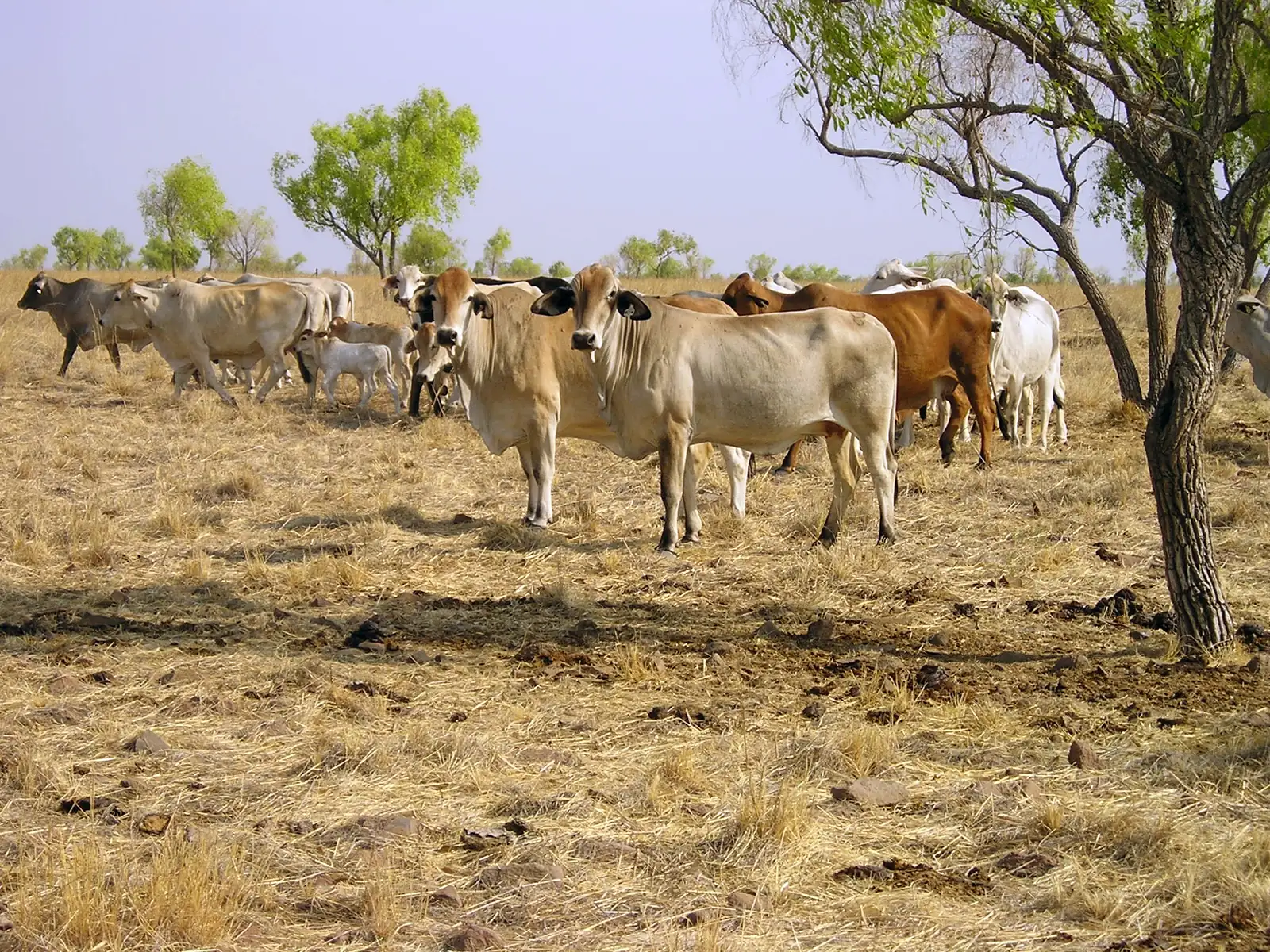
There is no single weight at which Australian cattle are killed. A domestic butcher's carcase and a Japan ox carcase are hundreds of kilograms apart, and the national average sits somewhere else again because it mixes steers, cows, grass and grain.
Why is there no ideal slaughter weight?
Processors pay on a grid of carcase weight, teeth and fat, and often colour and marbling. More Beef from Pastures says each market has its own specification, and that producers should ask the customer, because the numbers move (Meat & Livestock Australia n.d.).
The examples in that module, for southern Australia, are already far enough apart to show why one "finished weight" misleads:
| Market example | HSCW | Other limits printed with it |
|---|---|---|
| Local trade, MSA | 160 to 220 kg | 0 adult teeth, P8 fat 3 to 10 mm, ossification under 180 |
| Japan | 300 to 420 kg | 0 to 6 adult teeth, P8 fat 7 to 22 mm |
| European Union | 320 to 420 kg | 0 to 4 adult teeth, P8 fat 6 to 22 mm, HGP free in this example |
A 200 kg carcase can be right for one grid and a long way light for another. The animal's age, read from its teeth, is part of the same gate. How to count those teeth is in how to tell cattle age by teeth.
What liveweight do feedlot exit tables use?
The same MLA module prints liveweight equivalents beside its feedlot exit specifications. They are the on the hoof span that matches the carcase band for that program, not a second national average (Meat & Livestock Australia n.d.):
- About 100 days on feed: 540 to 720 kg liveweight.
- About 150 days: 550 to 750 kg.
- About 120 days: 550 to 800 kg.
- 220 days or more: 670 to 800 kg.
Hot standard carcase weights on the rows that extracted cleanly were 380 to 450 kg for the long fed program, 300 to 420 kg after 150 days, and 300 to 450 kg after 120 days. Entry weights for those same programs, which are lower, are in what weight a feeder steer should be.
Saleyard language is wider again. The December 2024 heavy steer indicator covers grown steers of 400 to 750 kg liveweight bought by processors, any muscle and fat score. MLA describes that indicator as cattle typically headed for domestic processing (Meat & Livestock Australia 2024). A 400 kg steer and a 750 kg steer are both inside it. The indicator is a price series, not a finishing target. The processor cow indicator on the same sheet is cows of 400 kg and over, bought by processors, often for lean export beef. That is a cow class, not a finished steer class.
What did Australian cattle actually weigh in 2025?
Grids say what was asked. Slaughter statistics say what was killed. MLA, reporting Australian Bureau of Statistics data, put the national average carcase weight for 2025 at 309 kg a head. That was 47 kg heavier than two decades earlier, and below the peak of 324 kg a head in the first quarter of 2022 (Meat & Livestock Australia 2025).
The average is pulled around by who is in the kill. MLA, citing the Australian Bureau of Statistics, gives female carcases at 273 kg a head and male carcases at 345 kg. Those two weights are not the 2025 annual average. The 309 kg figure is the one MLA gives for 2025 (Australian Bureau of Statistics 2025; Meat & Livestock Australia 2025). From the start of 2022 to the third quarter of 2025, female throughput grew faster than male throughput, and in the September 2025 quarter females were 53 per cent of turnoff. More cows in the mix makes the national average lighter even when steers are not getting smaller.
Feed type moves it the other way. MLA says that over the past decade, grainfed turnoff weights have been about 40 kg heavier than grassfed. By the June 2025 quarter, grassfed cattle were 62 per cent of turnoff, after grassfed numbers had grown much faster than grainfed numbers since late 2021. More grassfed cattle in the kill is one reason the 2025 average sat under the 2022 peak (Meat & Livestock Australia 2025).
So 309 kg is a real national carcase average for that year. It is not the weight you should finish a steer to. A local trade grid can want a carcase near the bottom of the 160 to 220 kg band, and a long fed grid can want one near 380 to 450 kg. Both animals are "finished". They are finished for different buyers.
How do you get from liveweight to carcase weight?
Divide is the wrong word. Carcase weight is liveweight multiplied by dressing percentage, and dressing percentage moves with fat, gut fill, breed type and whether the animal is a cow or a steer. The ranges and the formula are in dressing percentage in cattle. Do not apply one percentage to every beast and call the result a target.
If you are selling on a liveweight grid instead of over the hooks, the weighing conditions are part of the price. A full animal and an animal off feed overnight are not the same commodity. That loss is covered in how much weight cattle lose in transport.
Where does CattleScale fit?
CattleScale gives an estimated weight from a photograph, with a range around that estimate. An optional printed ruler sheet in the photo can make the reading sharper. It is an estimate, not a weigh scale, and it does not estimate a carcase. It can give you a rough idea of which animals look near a liveweight band before you weigh them for a grid. The kilograms you sell on, live or dressed, need a scale or a processor's scales. Do not book a kill slot on a photo.
Frequently asked questions
What is a good slaughter weight for cattle in Australia?
It is the grid you are selling into. MLA examples include 160 to 220 kg hot standard carcase weight for local trade MSA, 300 to 420 kg for a Japan specification, and 320 to 420 kg for an EU specification (Meat & Livestock Australia n.d.). Ask the buyer, because grids change.
What is the average carcase weight of Australian cattle?
MLA, reporting the Australian Bureau of Statistics, gives 309 kg a head for 2025. The same article gives female carcases at 273 kg and male carcases at 345 kg. Those sex splits are ABS figures in the article, not the 2025 average (Australian Bureau of Statistics 2025; Meat & Livestock Australia 2025).
What liveweight is a finished steer?
MLA's feedlot exit examples span about 540 to 800 kg depending on days on feed, and the heavy steer saleyard indicator covers grown steers from 400 to 750 kg (Meat & Livestock Australia n.d.; Meat & Livestock Australia 2024). Those are different lists.
Why is the national average not the target?
The average mixes cows and steers, and grassfed and grainfed cattle. MLA, citing the Australian Bureau of Statistics, gives female carcases at 273 kg against 345 kg for males, and grainfed turnoff about 40 kg heavier than grassfed over the past decade. The 273 kg and 345 kg figures are not the 2025 annual average (Australian Bureau of Statistics 2025; Meat & Livestock Australia 2025). Your grid is narrower than that mix.
References
- Australian Bureau of Statistics (2025) Livestock Products, Australia, September 2025. Canberra: Australian Bureau of Statistics. Available at: https://www.abs.gov.au/statistics/industry/agriculture/livestock-products/sep-2025 (Accessed: 10 October 2026).
- Meat & Livestock Australia (2024) National cattle indicators. National Livestock Reporting Service, December 2024. Sydney: Meat & Livestock Australia. Available at: https://www.mla.com.au/contentassets/c515412afca74d64baadbd1d301e1750/job34771_nlrs-cattle-indicator-specifications_jan25.pdf (Accessed: 10 October 2026).
- Meat & Livestock Australia (2025) 'Carcase weights dip but long-term productivity is intact', Meat & Livestock Australia, 12 December. Available at: https://www.mla.com.au/news-and-events/industry-news/carcase-weights-dip-but-long-term-productivity-trend-is-intact/ (Accessed: 10 October 2026).
- Meat & Livestock Australia (n.d.) 'Tool 7.01: Beef cattle market specifications', More Beef from Pastures. Available at: https://mbfp.mla.com.au/meeting-market-specifications/tools/tool-7.01beef-cattle-market-specifications (Accessed: 10 October 2026).
This is general information, not advice for your herd or a particular animal. Check with your vet or adviser before you change feeding, treatment, joining or transport.