 CattleScale
How much does a cow eat a day? Dry matter intake, hay and energy needs by liveweight
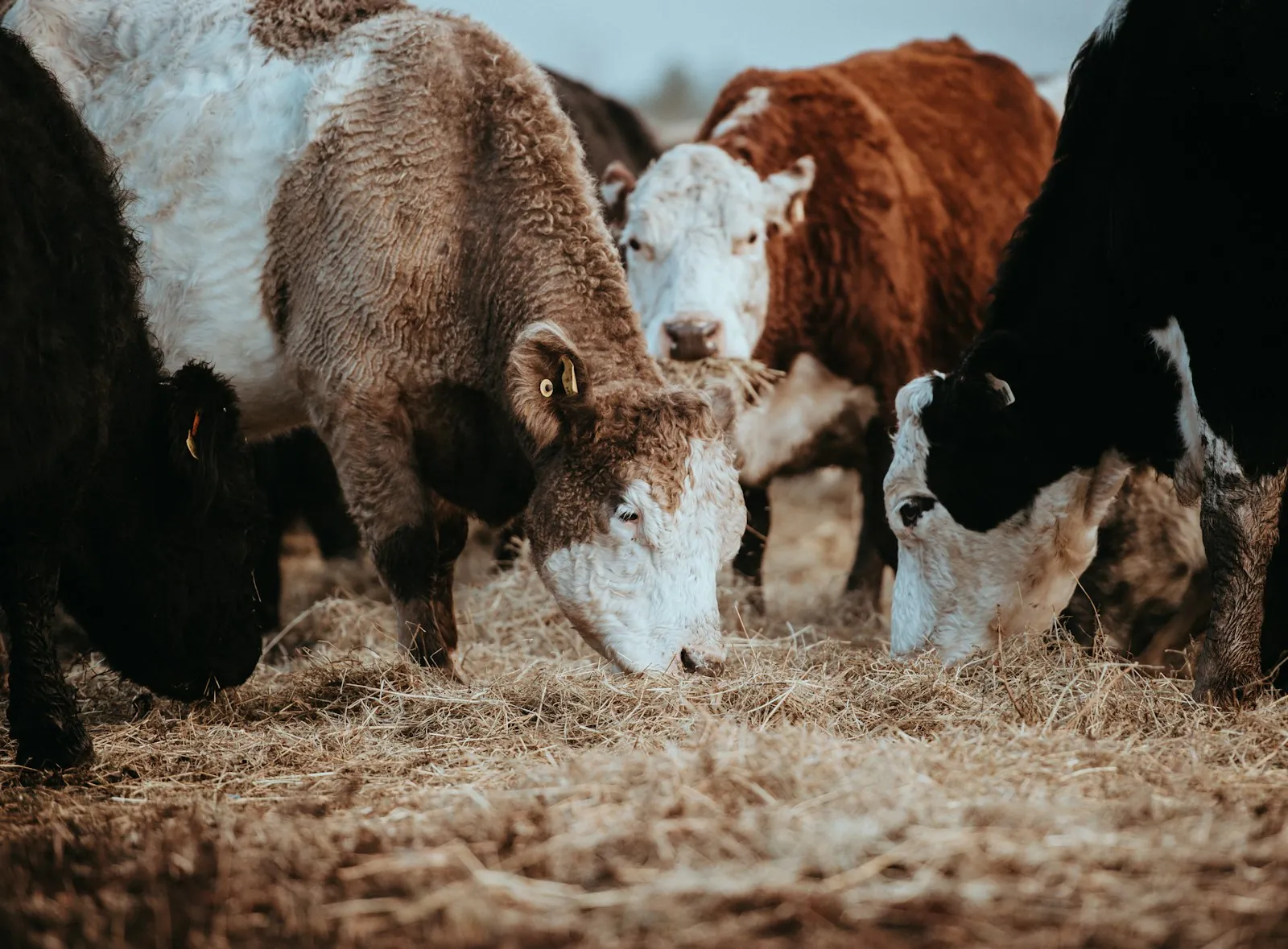
A beef cow can eat roughly 2 to 2.5 per cent of its liveweight a day in dry matter, so a 450 kg dry, pregnant cow can eat up to about 9.9 kg of dry matter a day (Agriculture Victoria 2025; Lalman and Holder n.d.). A cow feeding a calf eats more, cows on poor, stalky feed eat less, and the weight of feed actually going in is higher again once you add back the water in hay, silage or green grass.
How much does a cow eat per day in kg?
Intake is measured in kilograms of dry matter (DM) a day, often as a percentage of liveweight. Agriculture Victoria's drought feeding guide gives these maximum daily intakes (Agriculture Victoria 2025):
- Steers and heifers after weaning: 2.9 per cent of liveweight at 150 kg, 2.5 per cent at 300 kg, 2.4 per cent at 400 kg and 2.1 per cent from 500 kg up.
- Dry, pregnant mature cows: 2.2 per cent at 450 kg (9.9 kg DM), 2.1 per cent at 500 kg (10.5 kg DM) and 2.0 per cent from 550 kg up (11 to 13 kg DM).
These are ceilings, not targets. The guide explains that cattle "have an upper limit to their appetite", and that the higher the fibre in the feed, "the less the animal is able to consume" (Agriculture Victoria 2025).
What is dry matter intake, and how is it different from as fed?
Dry matter is the feed left after all the water is removed by oven drying, written as a percentage of the original sample. Energy and protein are measured on a dry matter basis so feeds with different water contents can be compared (Agriculture Victoria 2025).
"As fed" is the weight you actually put out or the cow actually bites off, water included. The gap is large for wet feeds. Typical dry matter contents from the same guide (Agriculture Victoria 2025):
- Young, immature grass dominant pasture: 23 per cent DM.
- Young lucerne: 17 per cent DM.
- Grass dominant silage: 45 per cent DM.
- Grass dominant pasture hay at flowering: 80 per cent DM.
- Grain and cereal straw: 90 per cent DM.
The guide's own example: silage at 45 per cent DM means one tonne holds only 450 kg of dry matter and 550 kg of water (Agriculture Victoria 2025). To turn a dry matter figure into an as fed amount, divide by the dry matter fraction. So 4.5 kg DM of that silage is 4.5 ÷ 0.45 = 10 kg as fed (Agriculture Victoria 2025).
How much do dry cows, lactating cows and growing cattle eat?
Dry cows
A dry cow at maintenance (not growing, not milking) has the lowest needs. Oklahoma State University's rule of thumb puts a dry cow's forage intake capacity at 1.8 per cent of body weight on low quality forage, 2.2 per cent on average quality forage and 2.5 per cent on high quality forage or lush growing pasture (Lalman and Holder n.d.).
Lactating cows
Milking raises appetite. On the same feed classes, the Oklahoma table gives lactating cows 2.2, 2.5 and 2.7 per cent of body weight (Lalman and Holder n.d.). The manual notes that "lactating cows consume considerably more of the same quality forage compared to gestating cows".
A 2026 Oklahoma State fact sheet summarising newer research reports that, on average, forage intake rose by 3.27 kg a day during lactation in the data behind a newer intake equation, at an average milk yield of 6.56 kg a day (Lalman and Brummer 2026).
Growing cattle
Weaners and yearlings eat a higher share of their liveweight than cows (Agriculture Victoria 2025), and they need better feed. Agriculture Victoria gives the example of a 300 kg steer that needs a diet of at least 10 MJ ME per kg DM to grow at 1 kg a day: possible on young green pasture, not on mature dry pasture (Agriculture Victoria 2025).
How does feed quality limit how much a cow can eat?
On forage, intake is generally limited by how much the digestive tract can hold (Lalman and Holder n.d.). High fibre feed is slow to digest, so the cow eats less of it. Higher quality feed digests and passes through faster, so the cow can eat more (Agriculture Victoria 2025; Lalman and Holder n.d.).
Digestibility is the share of what the animal eats that it keeps: at 70 per cent, 10 kg eaten means 7 kg used and 3 kg passed as dung. Agriculture Victoria links it to energy like this (Agriculture Victoria 2025):
- Active green growth: 75 per cent digestible, 10.5 MJ ME per kg DM.
- Late flowering: 60 per cent, 8 MJ ME.
- Dry grass and leaf: 55 per cent, 7.5 MJ ME.
- Dry stalks: 50 per cent, 6.5 MJ ME.
Feeds below 55 per cent digestibility are poor quality, and "even if cattle are given unlimited access, they will be unlikely to be able to maintain their liveweight" (Agriculture Victoria 2025). Straw is the classic case. It is high in fibre and very low in protein, and cattle "physically can't eat enough to satisfy even their maintenance energy requirements" (Agriculture Victoria 2025).
Protein matters too. When protein is short, cattle eat less than these figures suggest (Agriculture Victoria 2025; Lalman and Holder n.d.).
How much energy does a cow need a day?
Australian feed budgets use metabolisable energy (ME), measured in megajoules (MJ). It is the energy the animal can actually use from each kilogram of dry matter. Agriculture Victoria gives a maintenance formula (Agriculture Victoria 2025):
Maintenance energy (MJ ME a day) = (0.1 × liveweight in kg) + 5
On that formula a 450 kg cow needs 50 MJ ME a day just to hold weight. Growth, pregnancy and milk all add to it. The guide's tables show (Agriculture Victoria 2025):
- A 450 kg dry pregnant cow needs 59 MJ ME a day at six months pregnant, rising to 95 MJ at calving.
- A 450 kg cow with a calf one to four months old needs 100 to 127 MJ ME a day.
The guide recommends budgeting on energy first, then converting to kilograms of dry matter, because a kilogram of grass can hold 11 MJ ME in spring but 6 MJ ME in summer (Agriculture Victoria 2025).
Worked example: feeding a 450 kg dry cow
Illustrative numbers: the energy and dry matter values come from Agriculture Victoria (2025); the arithmetic is ours.
- Energy needed. (0.1 × 450) + 5 = 50 MJ ME a day at maintenance.
- Appetite ceiling. 2.2 per cent of 450 kg = 9.9 kg DM a day.
- On young green pasture (10.5 MJ ME per kg DM, 23 per cent DM): 50 ÷ 10.5 = 4.8 kg DM. As fresh grass: 4.8 ÷ 0.23 = about 21 kg a day. Easily within appetite.
- On pasture hay (8.5 MJ ME, 85 per cent DM): 50 ÷ 8.5 = 5.9 kg DM, or 5.9 ÷ 0.85 = about 6.9 kg of hay as fed.
- On dry standing grass (7.5 MJ ME): 50 ÷ 7.5 = 6.7 kg DM. Still possible.
- On cereal straw (about 5 MJ ME): 50 ÷ 5 = 10 kg DM. That is above the 9.9 kg ceiling, and on low quality forage the Oklahoma rule of thumb puts a dry cow nearer 1.8 per cent, or 8.1 kg DM. The cow cannot eat enough straw to hold weight (Agriculture Victoria 2025; Lalman and Holder n.d.).
Now move the same cow to calving at 95 MJ ME. On 8.5 MJ hay that is 95 ÷ 8.5 = about 11.2 kg DM, more than the 9.9 kg ceiling. A cow late in pregnancy needs better feed, not just more of it.
Quick reference: daily feed by liveweight
| Liveweight | Maximum DM intake | Maintenance energy (our arithmetic) | Hay as fed to maintain (our arithmetic) |
|---|---|---|---|
| 200 kg | 2.8%, 5.6 kg DM | 25 MJ ME | 3.5 kg |
| 300 kg | 2.5%, 7.5 kg DM | 35 MJ ME | 4.8 kg |
| 400 kg | 2.4%, 9.6 kg DM | 45 MJ ME | 6.2 kg |
| 450 kg | 2.2%, 9.9 kg DM | 50 MJ ME | 6.9 kg |
| 500 kg | 2.1%, 10.5 kg DM | 55 MJ ME | 7.6 kg |
| 600 kg | 2.0%, 12 kg DM | 65 MJ ME | 9.0 kg |
The hay column covers maintenance only: nothing for growth, late pregnancy, milk, cold or wastage. Treat it as a floor.
How much hay does a cow eat a day?
NSW DPI's emergency feeding table gives "as fed" hay amounts, assuming hay at 8.5 MJ ME (Andrews 2022):
- Dry stock at maintenance: 7.5 kg a day at 450 kg, 8 kg at 500 kg and 8.5 kg at 550 kg.
- Young stock gaining 0.2 kg a day: 5 kg at 200 kg, rising to 8 kg at 400 kg.
- Eight month pregnant cows of 600 kg and over, and lactating cows: hay alone is listed as short term feeding only, because they need a diet above 9 or 10 MJ ME.
The table also says to increase all amounts by 20 per cent in cold weather, using hay where possible (Andrews 2022).
Agriculture Victoria's full hand feeding table shows how fast needs climb. It lists 8.2 kg of hay a day for 450 kg adult dry stock, but 17.6 kg for a 450 kg cow with a four month old calf, and flags that amount as more than the cow may be able to physically eat (Agriculture Victoria 2025).
How much does a cow eat in a month and a year?
Illustrative numbers, our arithmetic, for one 450 kg dry cow fed hay at NSW DPI's 7.5 kg a day (Andrews 2022):
- Per month (30 days): 7.5 × 30 = 225 kg of hay as fed.
- Per year: 7.5 × 365 = 2,737.5 kg, or about 2.7 tonnes of hay as fed.
- Per year with the 20 per cent cold weather allowance: 9 × 365 = 3,285 kg, about 3.3 tonnes.
- Upper limit in dry matter: 9.9 kg DM × 365 = about 3.6 tonnes of dry matter a year, if the cow ate to full appetite every day.
A breeder that milks for part of the year needs more. Oklahoma State modelling found autumn calving herds needed more forage a year than spring calving herds, because cows milked for longer and calves grazed longer before weaning (Lalman and Brummer 2026).
What are DSE and AE ratings for cattle?
Dry sheep equivalent (DSE) is the most common unit for comparing the feed needs of different classes of stock, including cattle. More Beef from Pastures quotes NSW DPI's definition of 1 DSE as a 50 kg Merino wether, dry ewe or non-pregnant ewe maintaining condition, and lists these ratings for British breed cattle (Meat & Livestock Australia n.d.):
- Dry cow or steer at maintenance: 7 DSE at 400 kg, 8 DSE at 500 kg.
- Wet cow with a calf up to 3 months old: 14 DSE at 400 kg, 18 DSE at 500 kg.
- Wet cow with a calf of 7 to 10 months: 22 DSE at 400 kg, 25 DSE at 500 kg.
As MLA puts it, "100 cattle are not always 100 cattle". The same paddock might carry 100 dry cows for 90 days but 100 pregnant cows for only 50 (Meat & Livestock Australia n.d.).
Animal or adult equivalent (AE) is the unit used widely in northern Australia. WA DPIRD defines the standard animal as a 2.25 year old, 450 kg Bos taurus steer with zero weight gain, walking 7 km a day, needing 73 MJ ME a day, and puts one AE at 8.4 DSE (Western Australia Department of Primary Industries and Regional Development 2026). That factsheet uses a 45 kg wether for the DSE, not 50 kg. Systems differ, so pick one model and always use it (Meat & Livestock Australia n.d.).
DSE and AE ratings feed straight into stocking rate. See how many cattle per acre for how to turn them into head per hectare and per acre.
Why do you need the animal's liveweight to plan feed?
Every number here starts with liveweight. Agriculture Victoria is blunt: "To precisely plan feeding management, you need to have some idea of liveweights and expected growth rates of cattle. This can only be achieved by weighing cattle" (Agriculture Victoria 2025).
A 100 kg error on a cow moves its maintenance energy by 10 MJ ME a day on the formula above, about 1.4 kg of hay as fed (our arithmetic: 10 ÷ 8.5 ÷ 0.85 = 1.38). Over 100 cows for 90 days that is about 12.4 tonnes of hay (our arithmetic: 1.38 × 100 × 90 = 12,420 kg). Typical weights by age and breed are in how much does a cow weigh.
Scales are best. If you have none, how to estimate cattle weight without scales covers weigh tapes, formulas and photo methods. CattleScale estimates liveweight from photos and shows a range with a Low, Moderate or Good confidence rating. In its first test on 70 scale weighed cattle, the typical error was about 23 per cent, and the true weight fell inside the shown range about four times in ten. It is an estimate, not a weigh scale, so weigh a sample of the mob before you commit to buying feed.
Frequently asked questions
How much does a cow eat per day in kg?
About 2 to 2.5 per cent of its liveweight in dry matter. Agriculture Victoria gives a 450 kg dry pregnant cow a maximum of 9.9 kg of dry matter a day. The as fed weight is higher because hay, silage and grass all contain water.
How much hay does a cow eat a day?
NSW DPI's emergency feeding table gives 7.5 kg of hay as fed a day for a 450 kg dry cow at maintenance, and 8 kg at 500 kg. Add 20 per cent in cold weather. Lactating cows need better feed than hay alone.
How much does a cow eat in a year?
At 7.5 kg of hay a day, a 450 kg dry cow eats about 2.7 tonnes of hay a year as fed (our arithmetic). A cow eating to its full appetite of 9.9 kg dry matter a day would eat about 3.6 tonnes of dry matter a year.
Do lactating cows eat more than dry cows?
Yes. Oklahoma State's rule of thumb gives lactating cows 2.2 to 2.7 per cent of body weight against 1.8 to 2.5 per cent for dry cows on the same feed, and newer research found intake rose by about 3.3 kg a day during lactation.
What is dry matter intake?
It is the weight of feed eaten once all the water is taken out. Feed advisers use it because grass, silage and hay hold very different amounts of water, so dry matter is the only fair way to compare them.
References
- Agriculture Victoria (2025) Drought feeding and management of beef cattle: a guide for farmers and land managers 2025. Melbourne: Department of Energy, Environment and Climate Action. Available at: https://www.feedinglivestock.vic.gov.au/wp-content/uploads/2025/06/CS-1717-Drought-Feeding-and-Management-of-Beef-Cattle_V4.pdf (Accessed: 5 October 2026).
- Andrews, T. (2022) 'Hand feeding cattle in emergencies', Primefact 276, 3rd edn, NSW Department of Primary Industries. Available at: https://www.dpi.nsw.gov.au/__data/assets/pdf_file/0019/96202/Hand-feeding-catlle-in-emergencies.pdf (Accessed: 5 October 2026).
- Lalman, D. and Brummer, M. (2026) 'Comparison of methods to estimate forage intake in beef cows', AFS-3040, Oklahoma State University Extension. Available at: https://extension.okstate.edu/fact-sheets/print-publications/afs/comparison-of-methods-to-estimate-forage-intake-in-beef-cows-afs-3040-a.pdf (Accessed: 5 October 2026).
- Lalman, D. and Holder, A. (n.d.) 'Nutrient requirements of beef cattle', Chapter 16 in Oklahoma Master Cattleman Beef Cattle Manual, Oklahoma State University Extension. Available at: https://extension.okstate.edu/programs/master-cattleman/site-files/docs/beef-cattle-manual/chapter-16.pdf (Accessed: 5 October 2026).
- Meat & Livestock Australia (n.d.) '4: Determine carrying capacity and stocking rate', More Beef from Pastures: Pastoral, Meat & Livestock Australia. Available at: https://mbfp-pastoral.mla.com.au/managing-your-feedbase/determine-carrying-capacity-and-stocking-rate/ (Accessed: 5 October 2026).
- Western Australia Department of Primary Industries and Regional Development (2026) 'What are Animal Equivalents?', DPIRD factsheet. Available at: https://www.dpird.wa.gov.au/siteassets/documents/soil/what-are-animal-equivalents.pdf (Accessed: 5 October 2026).