 CattleScale
How much water does a cow drink a day? Cattle water requirements in litres
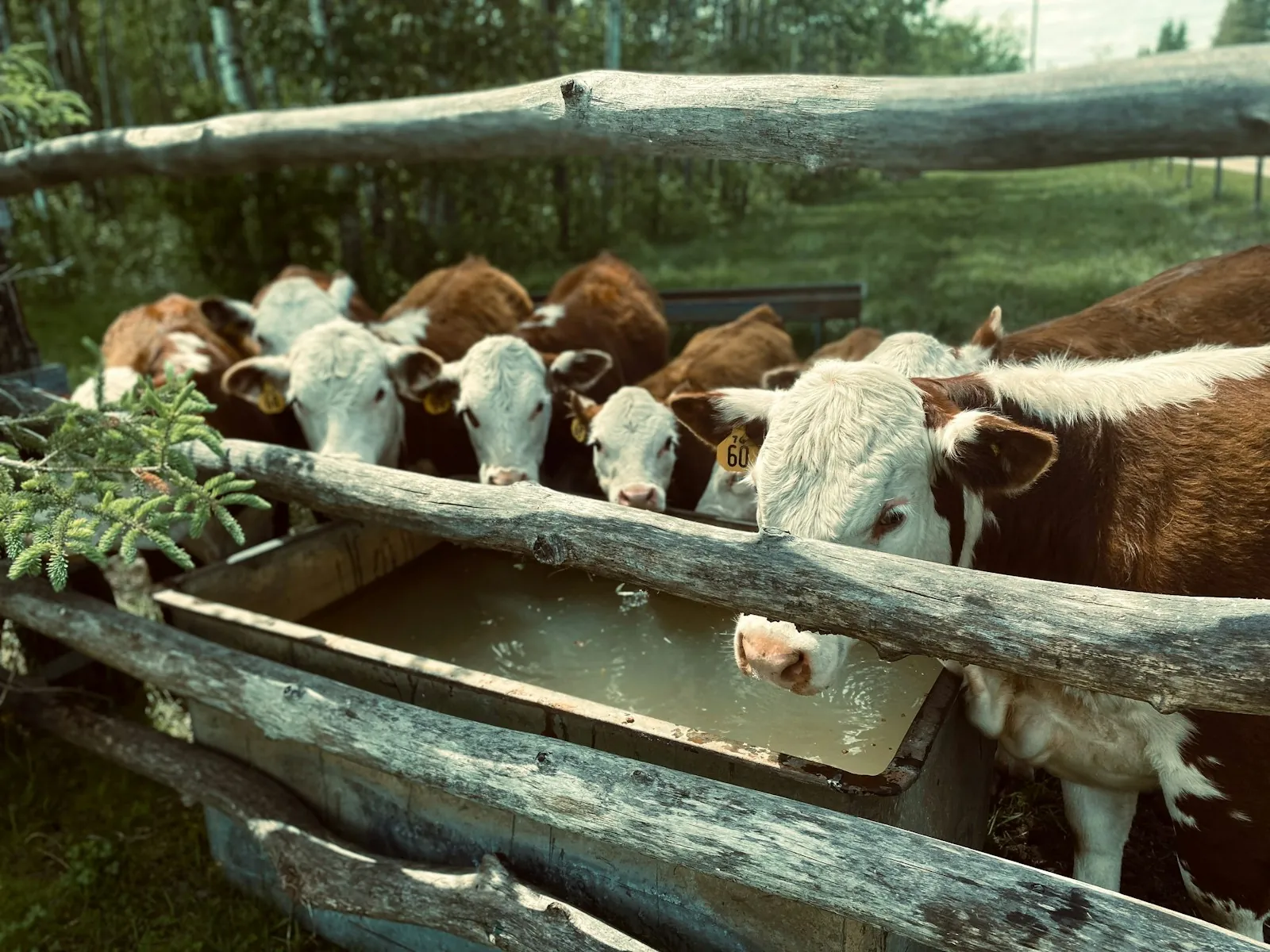
A dry beef animal of about 400 kg drinks roughly 35 to 80 litres of water a day, and a cow in milk on grassland drinks 40 to 100 litres, according to NSW Department of Primary Industries figures (Andrews 2019). Heat can almost double that: FutureBeef gives about 40 litres a day for a dry cow at 25°C and 70 litres at 32°C, so plan your water for the hottest week of the year, not an average one (Hamlyn-Hill 2011).
How much water does a cow drink a day?
It depends on class, size, feed, weather and the water itself (Hamlyn-Hill 2011). The table brings the published Australian figures together, plus a US extension figure for bulls.
| Class of cattle | Litres per head per day | Source |
|---|---|---|
| Young cattle | 25 to 50 | Andrews 2019 |
| Calves | 22 average, 30 peak | Hamlyn-Hill 2011 |
| Dry cattle, 400 kg | 35 to 80 | Andrews 2019 |
| Beef cattle, general guide | 45 average, 60 peak | Hamlyn-Hill 2011 |
| Dry cow at 25°C, and at 32°C (northern Australia) | 40, rising to 70 | Hamlyn-Hill 2011 |
| Lactating cows grazing grassland | 40 to 100 | Andrews 2019 |
| Lactating cows grazing saltbush | 70 to 140 | Andrews 2019 |
| Mature bulls, 635 kg to over 726 kg, 4°C to 32°C (US table, converted) | About 30 to 78 | Rasby and Walz 2025 |
NSW DPI notes that the ranges are wide because of water quality, overall salt intake, air temperature and breed (Andrews 2019). Feed and water go together, so read this alongside how much a cow eats a day.
How much water does a cow drink per day in litres, by liveweight?
The University of Nebraska notes that bulls need more water than dry cows because of their weight, and that "as cattle get heavier, daily water intake increases" (Rasby and Walz 2025). Its table, drawn from the US National Research Council, splits intake by weight and temperature. We have converted it to metric. The conversions are our arithmetic: 1 US gallon is 3.785 litres, 1 pound is 0.4536 kg, and °C is (°F minus 32) divided by 1.8 (National Institute of Standards and Technology n.d.).
| Cattle and liveweight | 4°C | 21°C | 32°C |
|---|---|---|---|
| Growing steers, heifers and bulls, 181 kg | 15 | 22 | 36 |
| Growing steers, heifers and bulls, 272 kg | 20 | 30 | 48 |
| Growing steers, heifers and bulls, 363 kg | 24 | 35 | 57 |
| Finishing cattle, 454 kg | 33 | 48 | 78 |
| Lactating cows, 408 kg and over | 43 | 64 | 69 |
| Mature bulls, 635 kg | 30 | 44 | 72 |
| Mature bulls, 726 kg and over | 33 | 48 | 78 |
The same publication gives a rule of thumb for a 32°C day: a growing animal or a lactating cow needs about 2 gallons per 100 pounds of body weight, and a dry cow or bull about 1 gallon per 100 pounds (Rasby and Walz 2025). In metric, that is roughly 17 litres per 100 kg and 8 litres per 100 kg (our arithmetic: 2 × 3.785 = 7.57 litres per 45.36 kg).
So you need a liveweight to plan water. Typical weights are in how much does a cow weigh. For your own cattle, scales are best. Failing that, CattleScale estimates liveweight from photos, with a range and a Low, Moderate or Good confidence rating. Its typical error in a first test on 70 scale weighed cattle was about 23 per cent, so it is an estimate, not a weigh scale.
How much water does a cow drink on a hot day?
A lot more. In northern Australia, a rise of 10°C "can almost double daily consumption, particularly if there is high humidity as well" (Hamlyn-Hill 2011). NSW DPI says water consumption "can increase by 80 per cent under extreme conditions", although ample shade helps offset this (Andrews 2019). In an analysis of seven feedlot studies, daily water intake rose in summer, and air temperature and the temperature humidity index were the main drivers of how much cattle drank (Arias and Mader 2011).
The requirements of Bos taurus cattle (British and European breeds) in hot conditions are higher than those of Bos indicus cattle (Hamlyn-Hill 2011).
Water temperature affects intake as well. Animals generally prefer water at or below body temperature and avoid warmer water, and cool water is preferred in hot conditions (Andrews 2019).
How much water does a cow drink a day in winter?
Less. Water needs rise as temperature rises, and fall again in cool weather (Rasby and Walz 2025). In the Nebraska table, a wintering beef cow of about 408 kg drinks about 23 litres a day at 4°C, and one of about 499 kg about 25 litres (Rasby and Walz 2025, our conversion). The table notes that "water intake is constant up to 40°F" (4°C), so the table does not lower intake any further in colder weather.
Cattle on lush pasture drink less again: NSW DPI notes that "fresh green pasture can supply all an animal's water needs" (Andrews 2019). Keep water available anyway.
What else changes cattle water requirements?
- Lactation. Lactating cows may drink about 30 per cent more than dry cows (Hamlyn-Hill 2011).
- Dry feed and drought. Stock need more water as they eat more fibrous, less digestible feed, because the extra water helps move coarse feed through the gut (Andrews 2019).
- Green feed. Silage and pasture are high in moisture, while grain and hay are low, and cattle on watery feeds drink less (Rasby and Walz 2025).
- Salty water. Water above 2,000 mg/L total dissolved salts "will increase thirst and the daily intake of water" (Hamlyn-Hill 2011).
- Salt licks. Salt based licks or blocks increase water intake. If water quality is marginal, the extra salt may depress appetite and cause digestive upsets (Andrews 2019).
Cattle that need more water because of lactation, salinity or dry feed may need to drink more than once a day. That shrinks how far they graze from water and the area of paddock they use (Andrews 2019), which matters when you work out how many cattle per acre a paddock will carry.
Worked example: water for a mob over a hot week
These are illustrative numbers to show the arithmetic, not research results. Take 100 dry cows in a heatwave, and plan at the top of the NSW DPI range for dry cattle, 80 litres a head a day (Andrews 2019).
- Daily demand: 100 head × 80 litres = 8,000 litres a day.
- One hot week: 8,000 × 7 = 56,000 litres.
- Flow rate: Agriculture Victoria says a reticulated (piped) system should deliver the daily peak demand in 4 hours, so all stock get a chance to drink (Sturmfels and Costin 2024). 4 hours is 240 minutes, so 8,000 ÷ 240 = about 33 litres a minute into the troughs.
- Storage: the same guide suggests at least 4 days of storage in reserve for a containment area (Sturmfels and Costin 2024). 4 × 8,000 = 32,000 litres of tank.
As a cross check, Agriculture Victoria's example is at least 67 litres a minute for 160 dry cattle (Sturmfels and Costin 2024). By our arithmetic, 67 × 240 ÷ 160 = about 100 litres a head a day, more generous than our 80.
How long will a dam last?
NSW DPI estimates dam volume as 0.4 × surface area × depth, the 0.4 allowing for sloping sides. Its worked example is a 30 by 30 metre dam, 4 metres deep: 0.4 × 900 × 4 = 1,440 cubic metres, or 1.44 megalitres. At 60 per cent full it holds 864,000 litres. Taking off 15 per cent of full capacity as unusable (fouling, bogging) and 25 per cent of the current level for evaporation leaves 432,000 litres, enough for 100 lactating cows and calves at 70 litres a head a day for 61 days (Andrews 2019).
For our 100 dry cows at 80 litres, the same 432,000 litres lasts 432,000 ÷ 8,000 = 54 days (our arithmetic).
How much trough space and flow do cattle need?
Agriculture Victoria's guide for containment areas says a suitable trough for 160 cattle typically has 8 to 10 metres of accessible trough edge and holds 400 to 600 litres, and the water level must be kept close to full at all times (Sturmfels and Costin 2024). Scaling that down in proportion for our 100 cows gives about 5 to 6 metres of edge (our arithmetic, so treat it as a starting point).
- Keep troughs clean. Dust and algae cause odours and tastes, and salt builds up through evaporation (Andrews 2019). In containment areas, empty and clean troughs every 1 to 2 days (Sturmfels and Costin 2024).
- Fence off boggy dams. When dam levels fall, cattle wade through mud, the water gets fouled, and weak animals can bog and die. Fence the dam and pump or gravity feed water to troughs (Andrews 2019).
- Watch access. In saleyards, Western Australia's Department of Primary Industries and Regional Development (DPIRD) says pens must allow every animal to drink, including non-dominant or submissive ones (Department of Primary Industries and Regional Development 2023).
What water quality do cattle need?
Salt is the main test. Salinity is the sum of all the mineral salts in the water (Curran 2014). It is reported as total dissolved salts (TDS) in mg/L, the same as parts per million, or as electrical conductivity (EC): 1 dS/m equals 1,000 µS/cm, or about 640 mg/L (Andrews 2019).
| TDS (mg/L) | What it means for beef cattle | Source |
|---|---|---|
| Over 2,000 | Increases thirst and daily water intake | Hamlyn-Hill 2011 |
| Under 3,000 | Can be used continuously by all livestock | Glauert 2007 |
| Up to 4,000 | Optimal maximum for beef cattle | Andrews 2019 |
| 4,000 to 5,000 | Stock may at first be reluctant to drink | Hamlyn-Hill 2011 |
| 5,000 to 10,000 | May be safe for short periods; potential loss of production and decline in health and condition | Andrews 2019; Hamlyn-Hill 2011 |
Young animals, heavily pregnant or lactating females, and aged or weak stock are less tolerant of salty water (Andrews 2019). Animals with green feed can tolerate saltier water than those with only bush or scrub to eat (Glauert 2007). Dams and tanks often get saltier over summer through evaporation (Glauert 2007), and so do troughs and shallow tanks (Andrews 2019), just as cattle drink the most. NSW DPI also lists a maximum chloride level of 4,000 mg/L for beef cattle and a pH range of 6.5 to 8.5 (Curran 2014). Test water you are unsure of (Hamlyn-Hill 2011).
Salt poisoning in cattle shows as excessive thirst, abdominal pain, loss of appetite, diarrhoea and increased urination, followed by weakness, muscle tremors and rapid loss of condition. Move affected stock to fresh water, but restrict it to small amounts, often, at first, because unlimited fresh water can make more animals sick. If further treatment is needed, consult your vet (Glauert 2007).
Blue-green algae
Some blue-green algae make toxins that can kill livestock, sometimes suddenly and several at once. Warning signs in a dam include a sudden overnight change of colour and a scum that "often looks like green acrylic paint", and Agriculture Victoria advises treating any bloom as toxic until tested (Agriculture Victoria 2016). Its advice:
- check dams and troughs at least 2 or 3 times a week in hot, dry weather;
- if you suspect a bloom, take stock off that water, give them another supply and send a sample for testing;
- call a vet if animals show signs of poisoning, such as muscle tremors, breathing distress, convulsions, jaundice or sensitivity to sunlight (Agriculture Victoria 2016).
Be careful with algicides. Killing the algae releases more toxin, and Agriculture Victoria says stock should be kept off treated water for at least 28 days unless toxin levels are monitored (Agriculture Victoria 2016).
What are the signs of dehydration and heat stress in cattle?
Cattle are most comfortable between 5°C and 25°C, and humidity makes heat stress worse even at moderate temperatures (Cave 2026). Heat stressed cattle pant, stand rather than lie down, seek shade, drink more and eat less (Cave 2026). Other signs are a faster breathing rate, more saliva, listlessness and lethargy (Agriculture Victoria 2024).
Dehydration limits an animal's ability to manage heat load and can predispose it to heat stress (Department of Primary Industries and Regional Development 2023). DPIRD describes three quick checks:
- Gums and nose. If the mucous membranes feel dry or tacky to a light touch, the animal is visibly dehydrated.
- Skin tent. Pinch the loose skin over the point of the shoulder. It should flatten in about a second. If it stays tented for more than 4 seconds, the animal is visibly dehydrated.
- Eyes. There should be no gap between the eyeball and the surrounding tissue. Sunken eyes mean dehydration (Department of Primary Industries and Regional Development 2023).
In Western Australia, visibly dehydrated cattle must not be transported or sold at a saleyard (Department of Primary Industries and Regional Development 2023).
What to do
- Check stock daily in hot weather (Cave 2026).
- Give unlimited access to shade or shelter and cool, clean drinking water (Cave 2026). Shelter should cut out sun but still let air move, and there needs to be enough for every animal, because crowded shade makes cattle bunch up and share heat (Agriculture Victoria 2024).
- Avoid moving cattle in the hottest part of the day, and offer good feed in the cooler evening (Cave 2026).
- Treat a heat stressed animal by moving it into shade and giving clean, cool water. If it does not improve, call a vet straight away (Agriculture Victoria 2024).
- Give young, old and sick animals extra care (Agriculture Victoria 2024).
Frequently asked questions
How much water does a cow drink per day in litres?
A dry 400 kg beef animal drinks about 35 to 80 litres a day, and a lactating cow on grassland 40 to 100 litres, according to NSW DPI. Young cattle drink about 25 to 50 litres.
How much water does a cow drink on a hot day?
Up to nearly double a mild day. FutureBeef says a 10°C rise can almost double intake, with a dry cow going from about 40 litres at 25°C to 70 litres at 32°C, and more in very hot weather.
How much water does a cow drink a day in winter?
Less than in summer. A US table converted to metric puts a wintering beef cow of about 408 to 499 kg at about 23 to 25 litres a day at 4°C. Cattle on lush green pasture may drink less again, but should always have water available.
What salinity can beef cattle drink?
NSW DPI gives 4,000 mg/L total dissolved salts as the optimal maximum for beef cattle, with 5,000 to 10,000 mg/L possibly safe only for short periods. FutureBeef warns that 5,000 to 10,000 mg/L can mean a loss of production and a decline in health and condition.
How fast should water flow into a cattle trough?
Fast enough to deliver the mob's whole daily peak demand in 4 hours, says Agriculture Victoria. Its example is a minimum of 67 litres a minute for 160 dry cattle in a stock containment area.
References
- Agriculture Victoria (2016) 'Managing blue-green algae in farm water supplies', Agriculture Note LC0098. Agriculture Victoria. Available at: https://agriculture.vic.gov.au/farm-management/water/blue-green-algae-in-water/managing-bluegreen-algae-in-farm-water-supplies/Managing-Blue-Green-Algae-in-Farm-Water-Supplies.pdf (Accessed: 5 October 2026).
- Agriculture Victoria (2024) 'Providing shelter to help prevent heat stress in livestock', Agriculture Victoria media release, 12 February. Available at: https://agriculture.vic.gov.au/about/media-centre/media-releases/2024-releases/providing-shelter-to-help-prevent-heat-stress-in-livestock (Accessed: 5 October 2026).
- Andrews, T. (2019) 'Stocktaking water supply for livestock', Primefact 269, 7th edn. NSW Department of Primary Industries. Available at: https://www.dpird.nsw.gov.au/__data/assets/pdf_file/0005/1478831/stocktaking-property-water-for-livestock.pdf (Accessed: 5 October 2026).
- Arias, R.A. and Mader, T.L. (2011) 'Environmental factors affecting daily water intake on cattle finished in feedlots', Journal of Animal Science, 89(1), pp. 245 to 251. Available at: https://doi.org/10.2527/jas.2010-3014 (Accessed: 5 October 2026).
- Cave, J. (2026) 'Understanding heat stress in livestock and ways to prevent it', Agriculture Victoria media release, 17 February. Available at: https://agriculture.vic.gov.au/about/media-centre/media-releases/2026-releases/understanding-heat-stress-in-livestock-and-ways-to-prevent-it (Accessed: 5 October 2026).
- Curran, G. (2014) 'Water for livestock: interpreting water quality tests', Primefact 533, 2nd edn. NSW Department of Primary Industries. Available at: https://www.dpird.nsw.gov.au/__data/assets/pdf_file/0008/1674818/water-for-livestock-interpreting-water-quality-tests.pdf (Accessed: 5 October 2026).
- Department of Primary Industries and Regional Development (2023) 'Assessing sheep and cattle for dehydration for transport or sale', DPIRD, Government of Western Australia. Available at: https://www.dpird.wa.gov.au/globalassets/sheep-and-cattle-dehydration.pdf (Accessed: 5 October 2026).
- Glauert, S. (2007) 'Livestock and water salinity', Farmnote 249. Department of Agriculture and Food, Western Australia. Available at: https://futurebeef.com.au/wp-content/uploads/2011/09/Livestock_and_water_salinity_DAFWA.pdf (Accessed: 5 October 2026).
- Hamlyn-Hill, F. (2011) 'Water requirements for cattle', FutureBeef. Available at: https://futurebeef.com.au/resources/water-requirements/ (Accessed: 5 October 2026).
- National Institute of Standards and Technology (n.d.) 'NIST Guide to the SI, Appendix B.9: Factors for units listed by kind of quantity or field of science', NIST. Available at: https://www.nist.gov/pml/special-publication-811/nist-guide-si-appendix-b-conversion-factors/nist-guide-si-appendix-b9 (Accessed: 5 October 2026).
- Rasby, R. and Walz, T. (2025) 'Water requirements for beef cattle', G2060, Nebraska Extension, University of Nebraska-Lincoln. Available at: https://extensionpubs.unl.edu/publication/g2060/2025/pdf/view/g2060-2025.pdf (Accessed: 5 October 2026).
- Sturmfels, C. and Costin, B. (2024) 'Getting water infrastructure for stock containment sorted', Sheep Notes newsletter, Spring 2024. Agriculture Victoria. Available at: https://agriculture.vic.gov.au/support-and-resources/newsletters/sheep-notes-newsletter/spring-2024/getting-water-infrastructure-for-stock-containment-sorted (Accessed: 5 October 2026).